Final Proximity Space Systems

Let’s Talk Space

08Ground tests for proximity operations

One gravity,
six degrees of Freedom.

You cannot test a free-fall operation on the ground. The facilities that work around that, and the trade each one makes.

T minus 00:08:00   THE OBSTACLE

One gravity, six degrees of freedom

Every proximity operation happens in free fall. Every ground test happens in gravity. There is no facility that removes this, only facilities that work around it, and the choice of workaround determines what a test can and cannot prove.

Air bearing tables

Frictionless, but flat

A vehicle floats on a thin cushion of air over a polished granite surface, giving genuinely near-frictionless motion in three degrees of freedom: two translations and one rotation. Trade: the other three degrees do not exist. Excellent for control law behaviour, silent on out-of-plane motion.
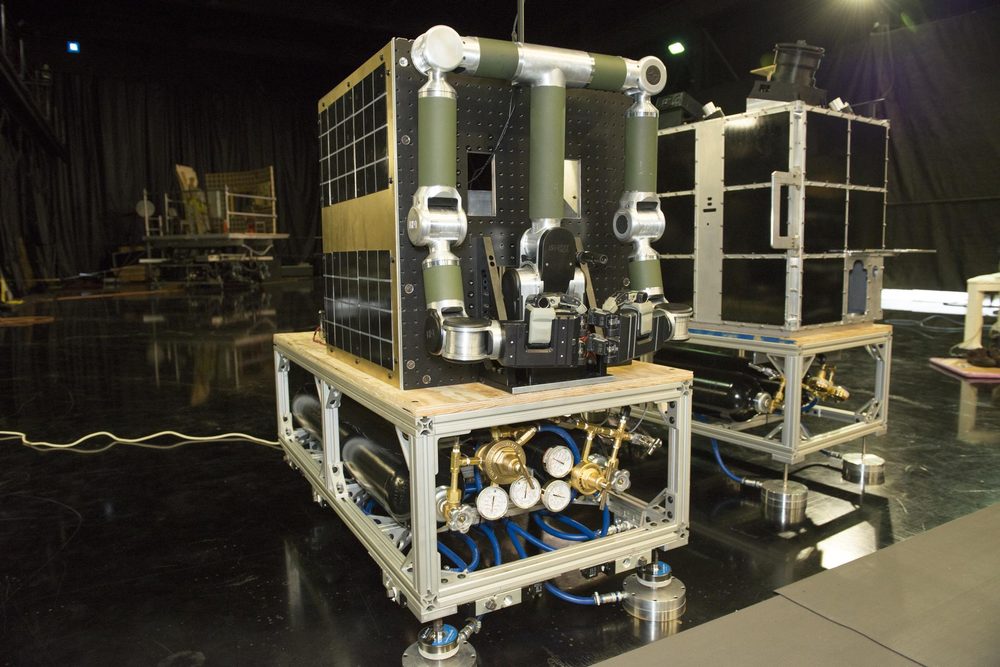
ESA, Orbital Robotics Laboratory

Two air-bearing vehicles floating on a polished flat floor at Marshall, rehearsing a chase and capture with robotic arms. NASA/MSFC/Fred Deaton.

Robotic facilities

All six, but not free

Two industrial robot arms hold mock-ups and move them according to a real-time orbital dynamics simulation, closing the loop with real sensors. DLR’s EPOS and similar facilities work this way. Trade: the dynamics are computed, not physical, so the test is only as good as the model, and arm bandwidth limits how fast an event can be reproduced.
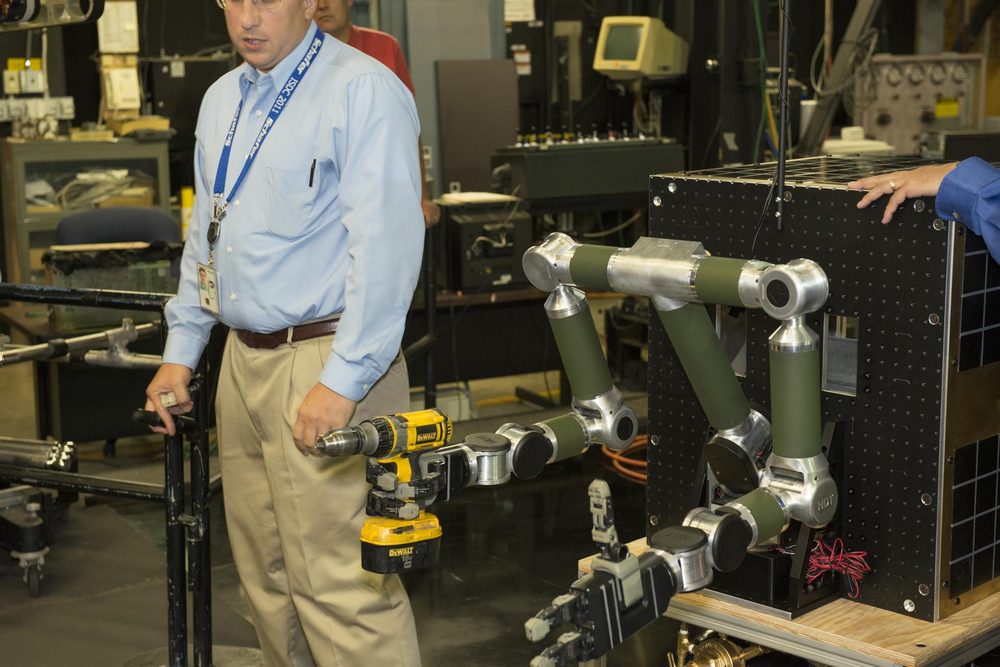
DLR, EPOS 2.0

A robotic arm working an instrumented testbed at Marshall, from the same demonstration campaign as the air-bearing frame above. NASA/MSFC/Fred Deaton.

Neutral buoyancy

Six degrees, heavily damped

Underwater, with the vehicle ballasted neutral. Used mainly for EVA rehearsal, which is precisely how Gemini 12 solved the spacewalk problem. Trade: water drag has no orbital analogue, so the dynamics are wrong even though the geometry is right.
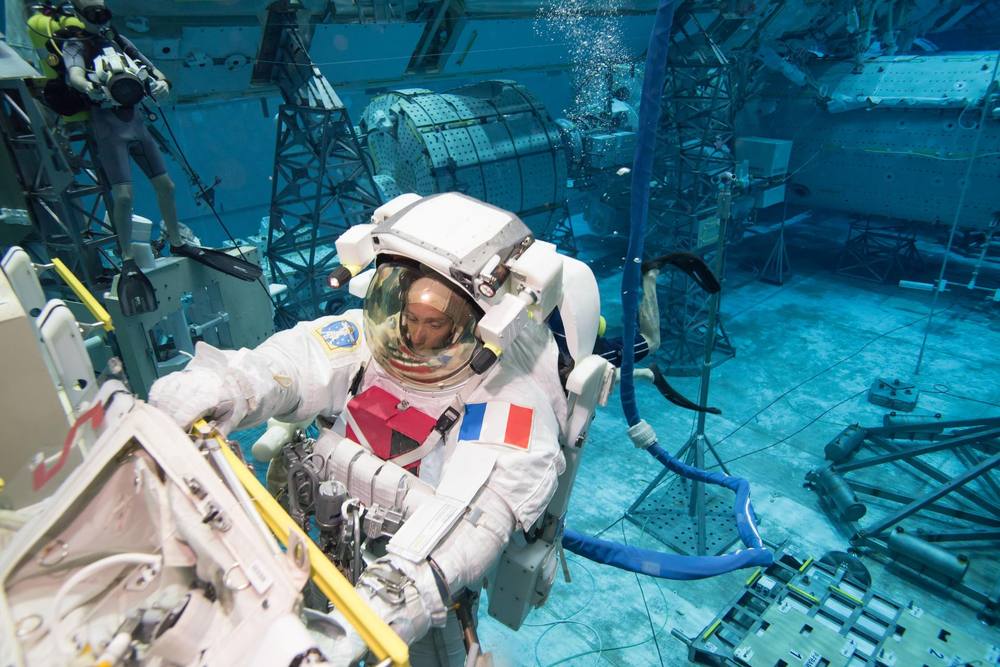
NASA, Neutral Buoyancy Laboratory

EVA training at the submerged station mockup in the Neutral Buoyancy Laboratory. NASA/Bill Brassard.

Parabolic flight

Real free fall, briefly

An aircraft flies a ballistic arc and everything inside it falls freely for roughly twenty seconds, with about thirty parabolas in a flight. The gravity is genuinely absent rather than compensated, which is what nothing else on this list can offer. Trade: twenty seconds, with residual accelerations from the pilot holding the arc, and a whole campaign measured in tens of usable minutes. Enough for a contact event or a release, not for an approach.
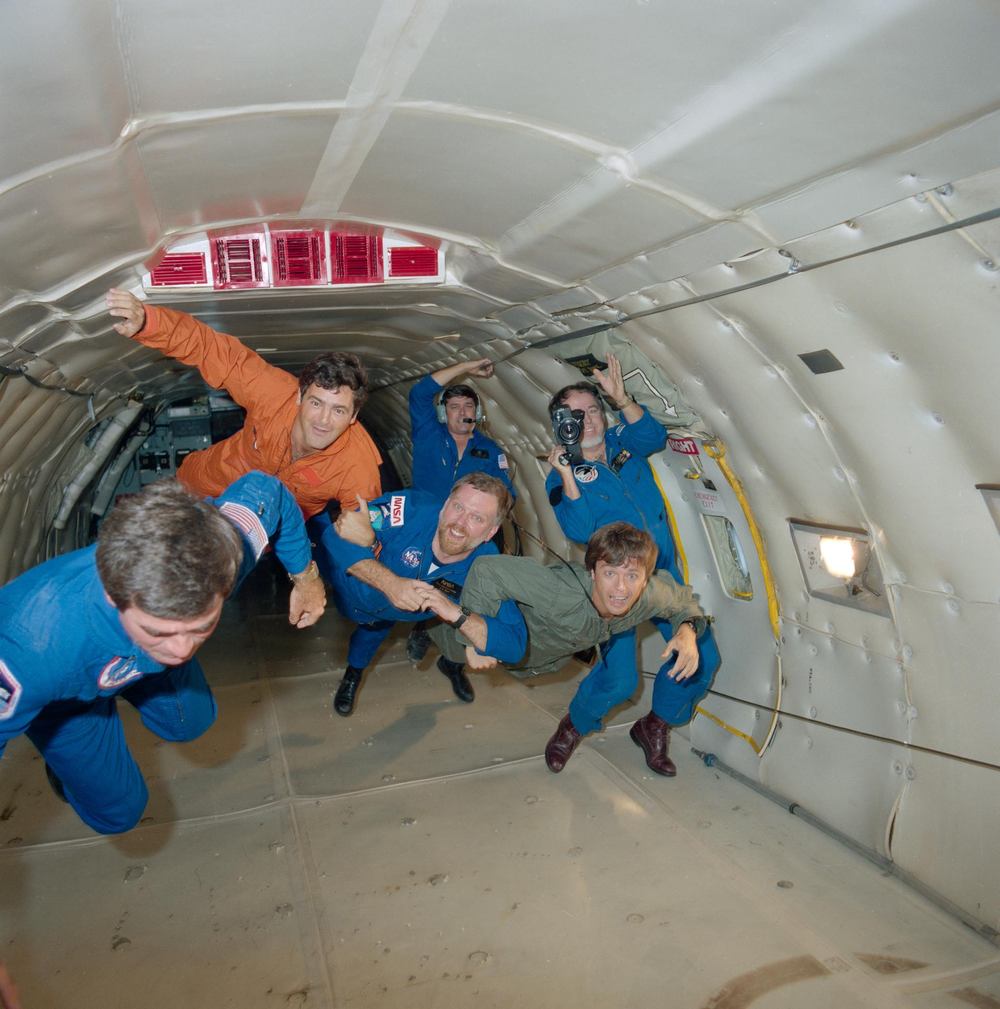
ESA, Parabolic flights

Trainees floating in the KC-135 cabin mid-parabola, 1984. About twenty seconds of weightlessness per arc. NASA, S84-40540.

Optical stimulation

The sensor’s whole world, simulated

The camera or lidar sees a rendered scene or a scaled physical mock-up under controlled lighting. The only practical way to exercise a vision-based navigation chain across sun angles, eclipse entry and specular glare. Trade: renderer fidelity becomes part of the test result.
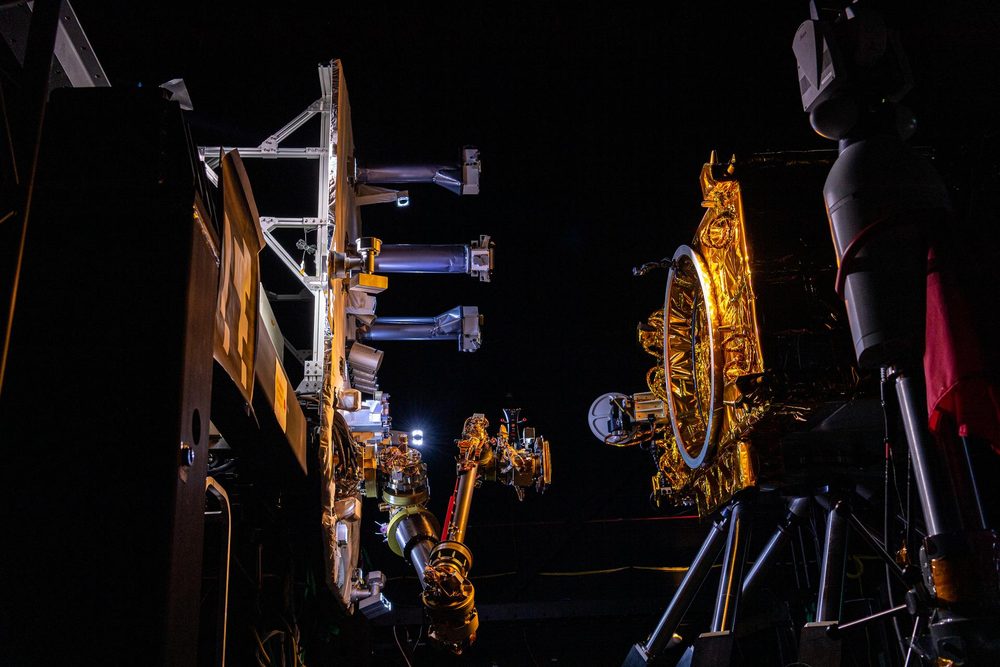
ESA, GNC and AOCS Laboratory

The OSAM-1 capture test bed inside the black-walled Robotic Operations Center at Goddard, mock-ups and controlled lighting standing in for orbit. NASA/Michael Guinto.

Suspension rigs

Gravity offloaded, mechanically

Cables and counterweights carry the weight while the vehicle moves. Trade: the rig has its own dynamics, and its friction and inertia contaminate exactly the small forces being measured.
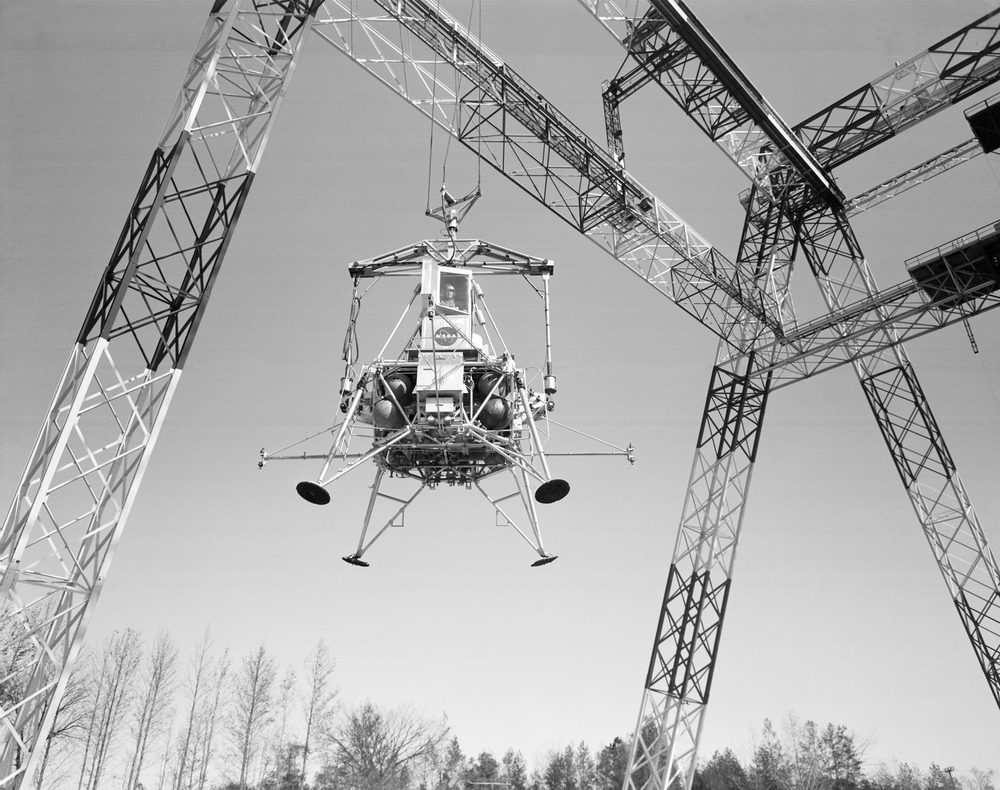
NASA, Lunar Landing Research Facility

A lunar lander under the gantry of Langley’s Lunar Landing Research Facility in 1967, cables carrying five sixths of its weight while a research pilot flies the rest. NASA/Bob Nye.

T minus 00:02:00   HOW TO USE THEM

Choosing the facility by the question

Ask an air bearing table

  • Does the control law behave with real thruster quantisation?
  • What does contact do to a floating body?
  • Is the guidance stable with real sensor noise?

Ask a robotic facility

  • Does the navigation chain hold pose through the whole approach?
  • What happens at the lighting transition into eclipse?
  • Does the docking mechanism latch at realistic rates and misalignments?

The useful discipline is to write down what a facility cannot show before booking it. Most ground-test surprises in flight come from a result being read as more general than the facility could support: a planar test taken as evidence about a tumbling target, or a rendered scene taken as evidence about real sunlight.

Ground testing is part of how we validate what we build. See the capabilities.

T minus 00:00:20   SOURCES

Where this comes from

DLR: European Proximity Operations Simulator (EPOS 2.0)

ESA: Orbital Robotics Laboratory, ESTEC

ESA: GNC, AOCS and Pointing Laboratory

NASA: Neutral Buoyancy Laboratory

Rybus, Tomasz, and Karol Seweryn. “Planar Air-Bearing Microgravity Simulators: Review of Applications, Existing Solutions and Design Parameters.” Acta Astronautica 120 (2016): 239–259.

Fehse, Wigbert. Automated Rendezvous and Docking of Spacecraft. Cambridge: Cambridge University Press, 2003.

All nine topics
PreviousVerification and validation in space systems NextIn-orbit rendezvous and docking: the Gemini missions