09In-orbit rendezvous and docking: the Gemini missions
Between 1964 and 1966, twelve flights turned rendezvous and docking from a theory into something people had actually done. Everything since rests on what these crews found out: Apollo, Mir, the ISS, every servicing mission being designed now.
T minus 00:09:00 WHY GEMINI
In 1961 the United States committed to landing on the Moon before the decade was out. The mission profile it settled on, lunar orbit rendezvous, depended on something nobody had ever done: two spacecraft finding each other in orbit and joining together. If that could not be made routine, the lunar module could not be left in orbit, and the whole architecture collapsed.
Mercury had proved a person could survive up there. It had not proved they could fly. A Mercury capsule went where its launch vehicle put it. Gemini was built to answer four questions that Apollo could not proceed without: could a crew change their own orbit, could two spacecraft rendezvous and dock, could a person work outside, and could a crew endure two weeks in space.
Between 1964 and 1966 the answer to all four went from unknown to demonstrated. That is the whole point of the programme.
T minus 00:06:00 THE SEQUENCE
Ordered by launch date, which is why Gemini 7 appears before 6A: 7 flew first and became the target 6A was launched to find.
8 Apr 1964
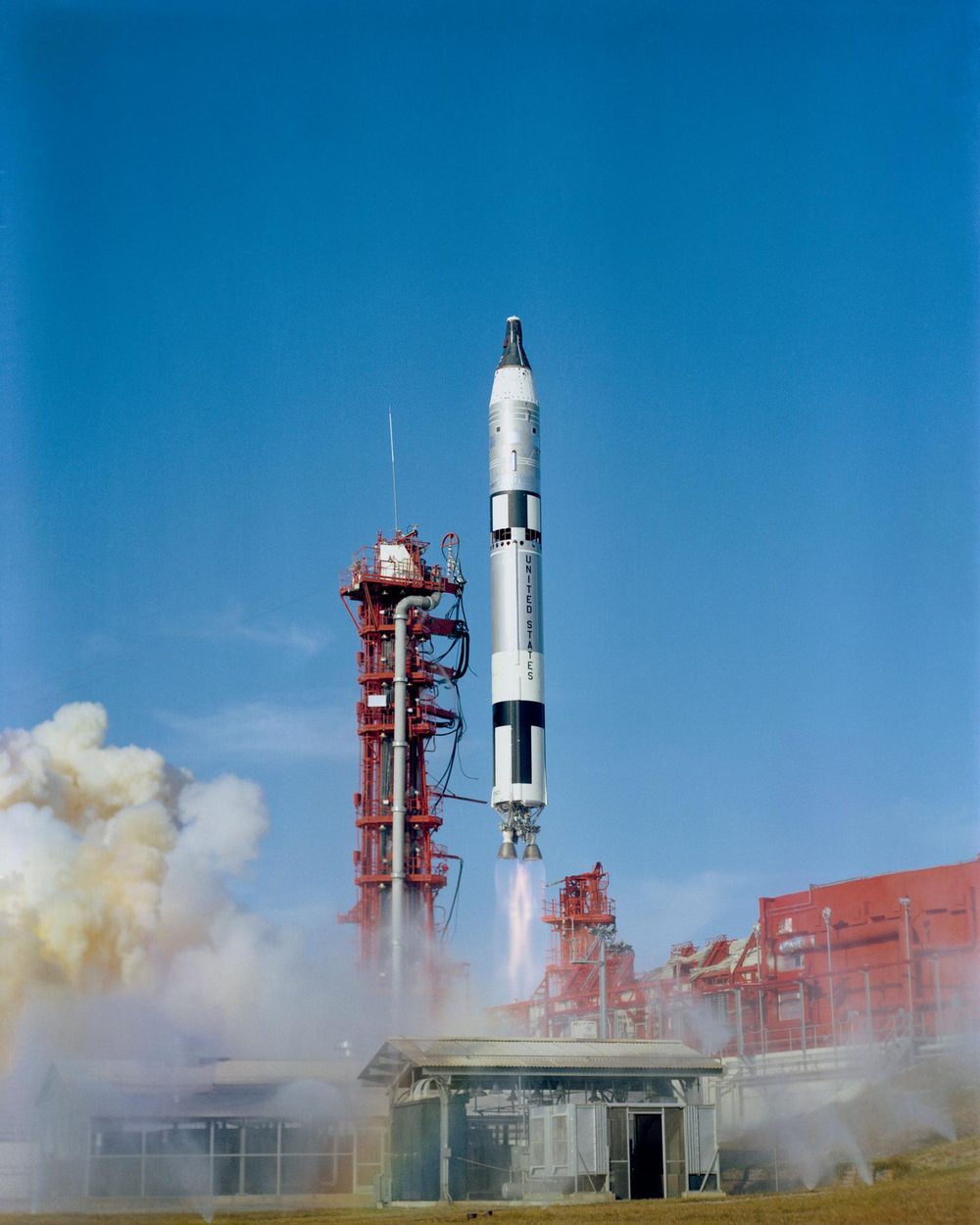
UncrewedA structural test of the spacecraft and the Titan II that carried it. No heat shield was fitted, because nothing was coming back. It proved the launch vehicle and the spacecraft could fly together.
Flying the first article unrecoverable was deliberate: the test asked one question, whether the spacecraft and the booster fly together, and nothing was allowed to complicate the answer.
19 Jan 1965
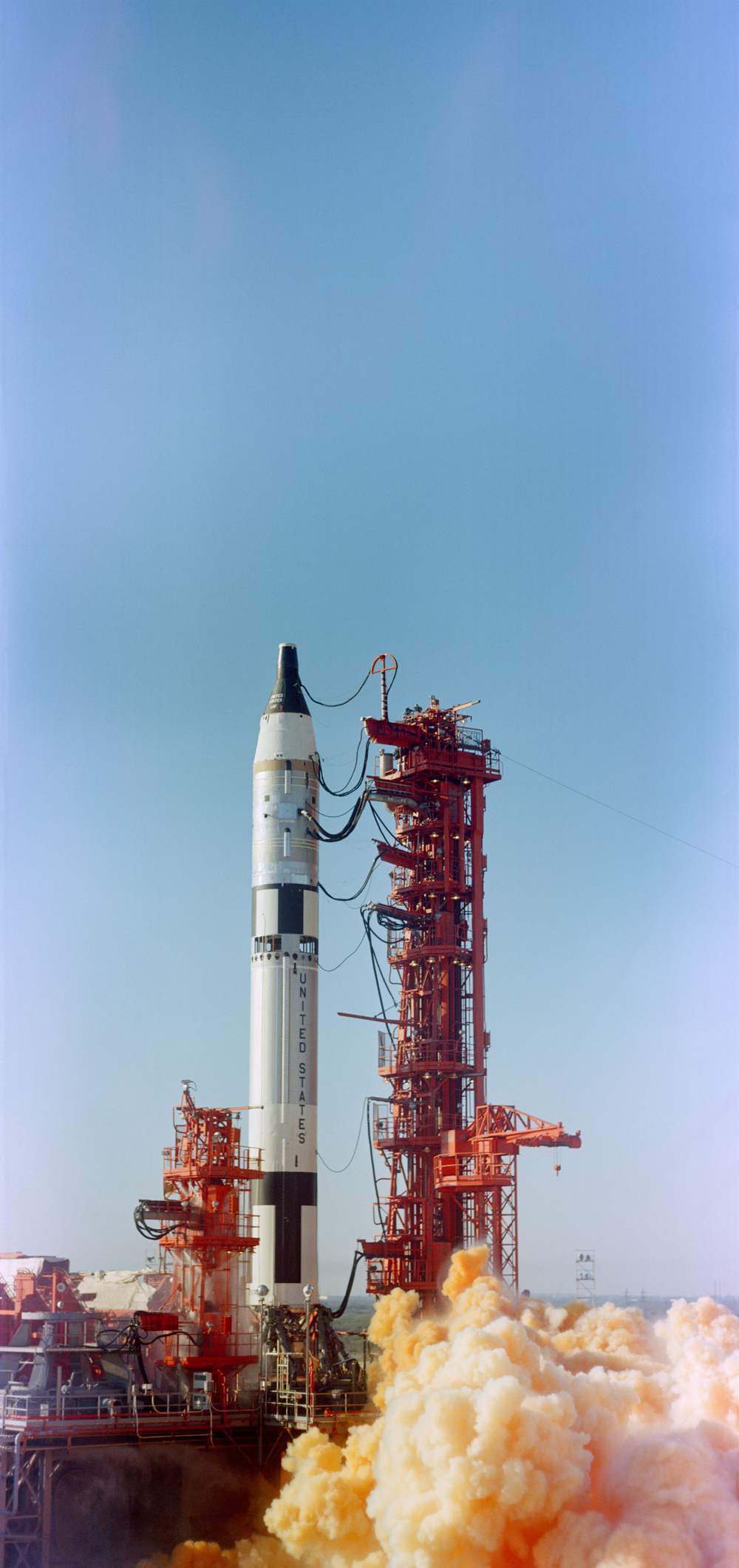
UncrewedA suborbital flight to test the heat shield and the re-entry systems. It survived, which is what cleared the way for a crew to fly the next one.
A suborbital lob is the cheapest way to buy twenty minutes of genuine re-entry heating, and twenty minutes was all the heat shield question needed.
23 Mar 1965
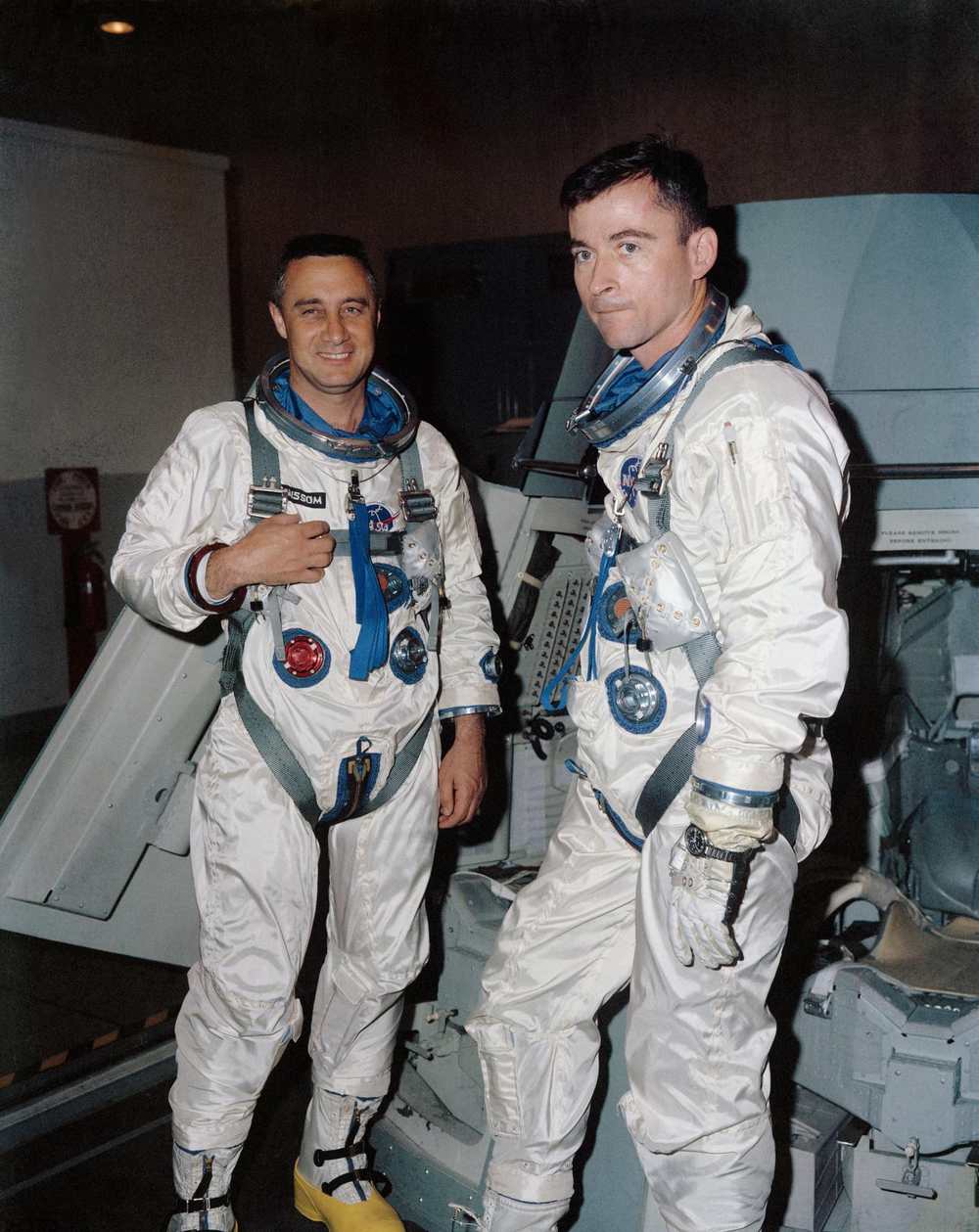
CrewedGus Grissom and John Young. The first time a crew changed their own orbit: the first manual orbital manoeuvre in spaceflight. Until Gemini 3, spacecraft went where the launch vehicle put them.
Until this flight, spacecraft went where their boosters put them. A crew changing their own orbit is the capability every rendezvous that followed stood on.
3 Jun 1965
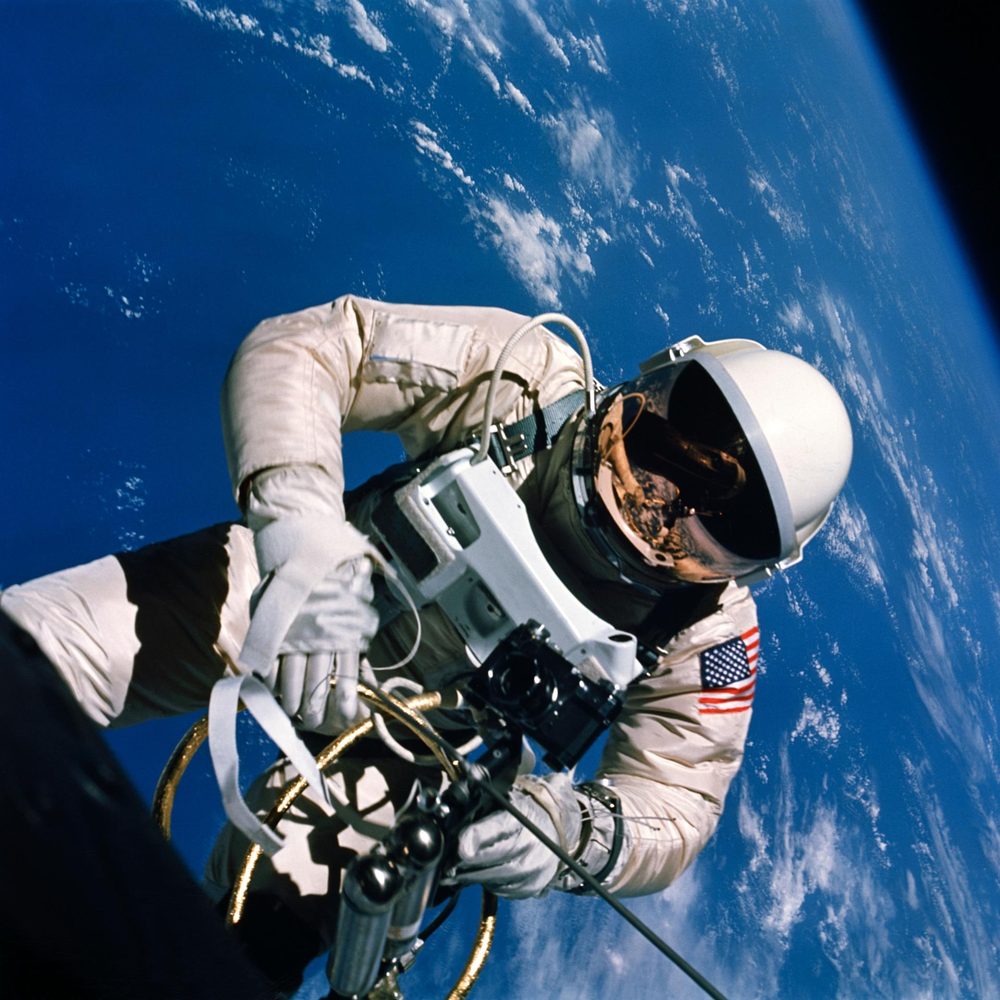
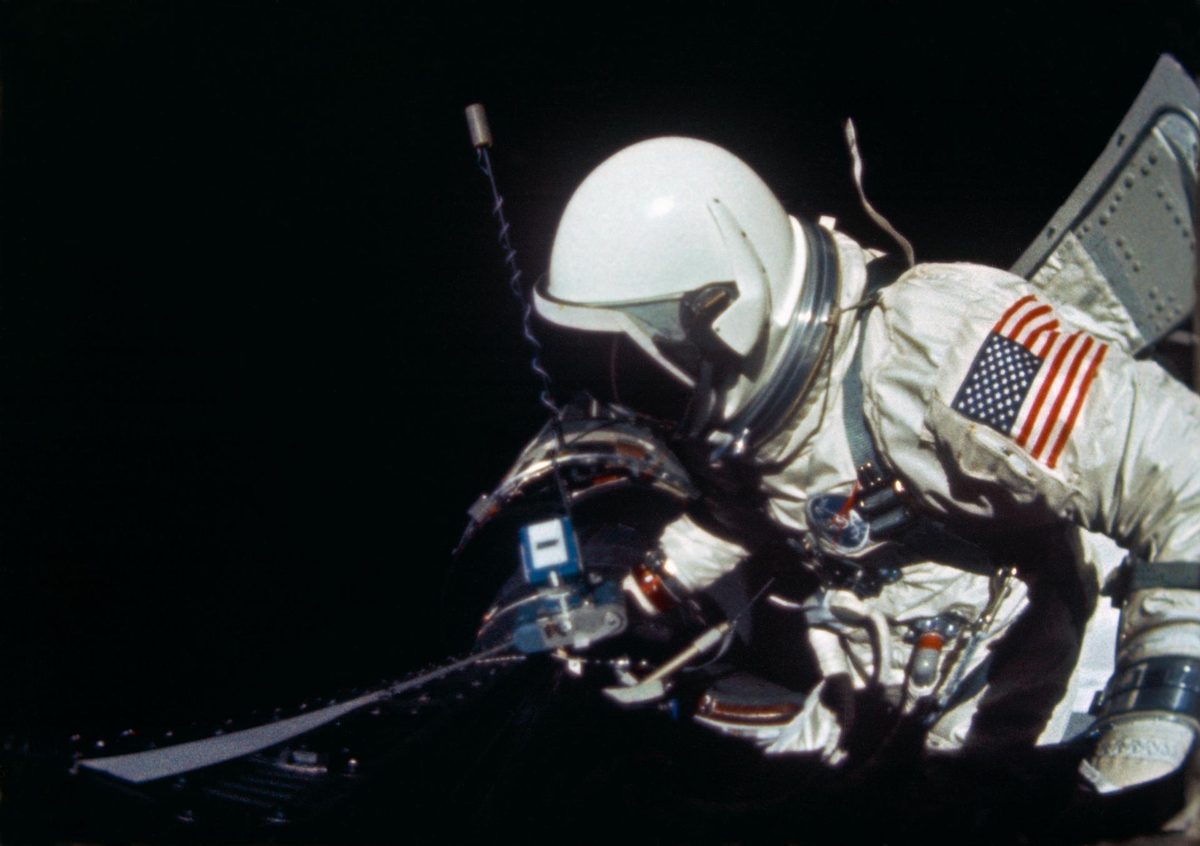
First Us EvaJames McDivitt and Edward White. White spent 23 minutes outside on a hand-held manoeuvring unit, the first American spacewalk. The mission also attempted a station-keeping exercise with the spent Titan stage and failed: thrusting straight at the target pushed them into a higher, slower orbit and it drifted away. The orbital mechanics of closing on something are not intuitive, and this is where that was learned in flight.
The station-keeping failure mattered more than the spacewalk. It showed that closing on an orbital target is a guidance problem, not a piloting problem, and intuition flies you away from what you chase.
21 Aug 1965
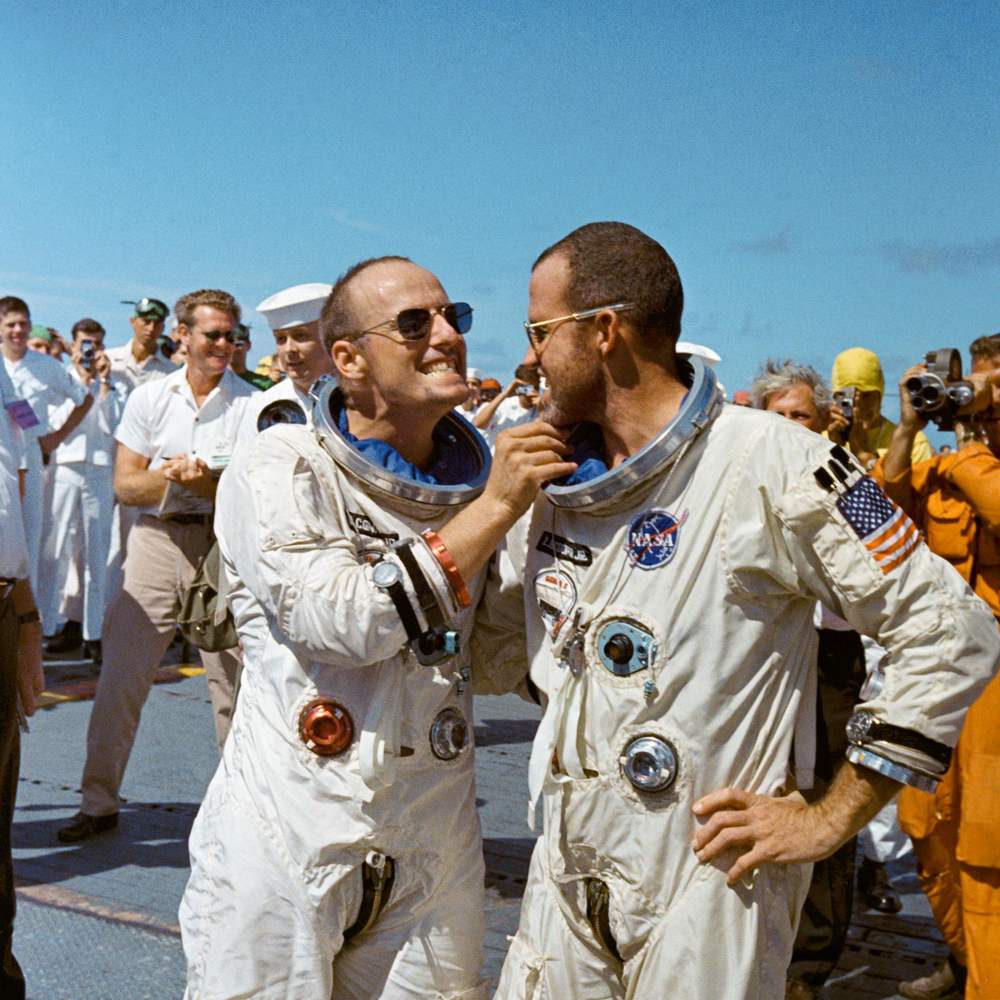
EnduranceGordon Cooper and Charles Conrad, eight days in orbit. Long enough to prove a crew could survive the round trip to the Moon. Seventeen experiments flew with them.
Eight days is the length of a lunar round trip. The endurance flights were lunar requirements being retired one by one, not record attempts.
4 Dec 1965
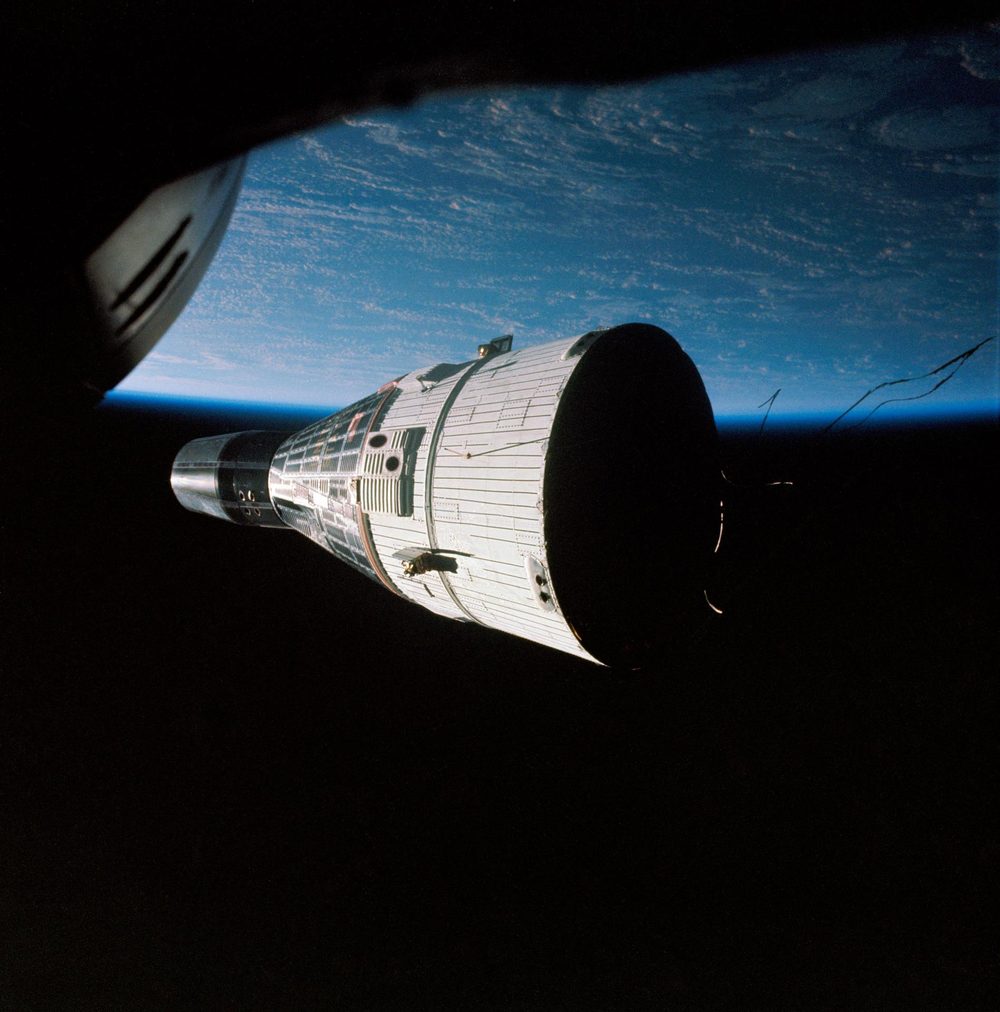
TargetFrank Borman and James Lovell, 206 orbits across nearly fourteen days, in a cabin roughly the size of the front of a small car. They then served as the rendezvous target for Gemini 6A.
Fourteen days in a cabin the size of a car’s front seats settled the medical questions Apollo could not fly without answering.
15 Dec 1965
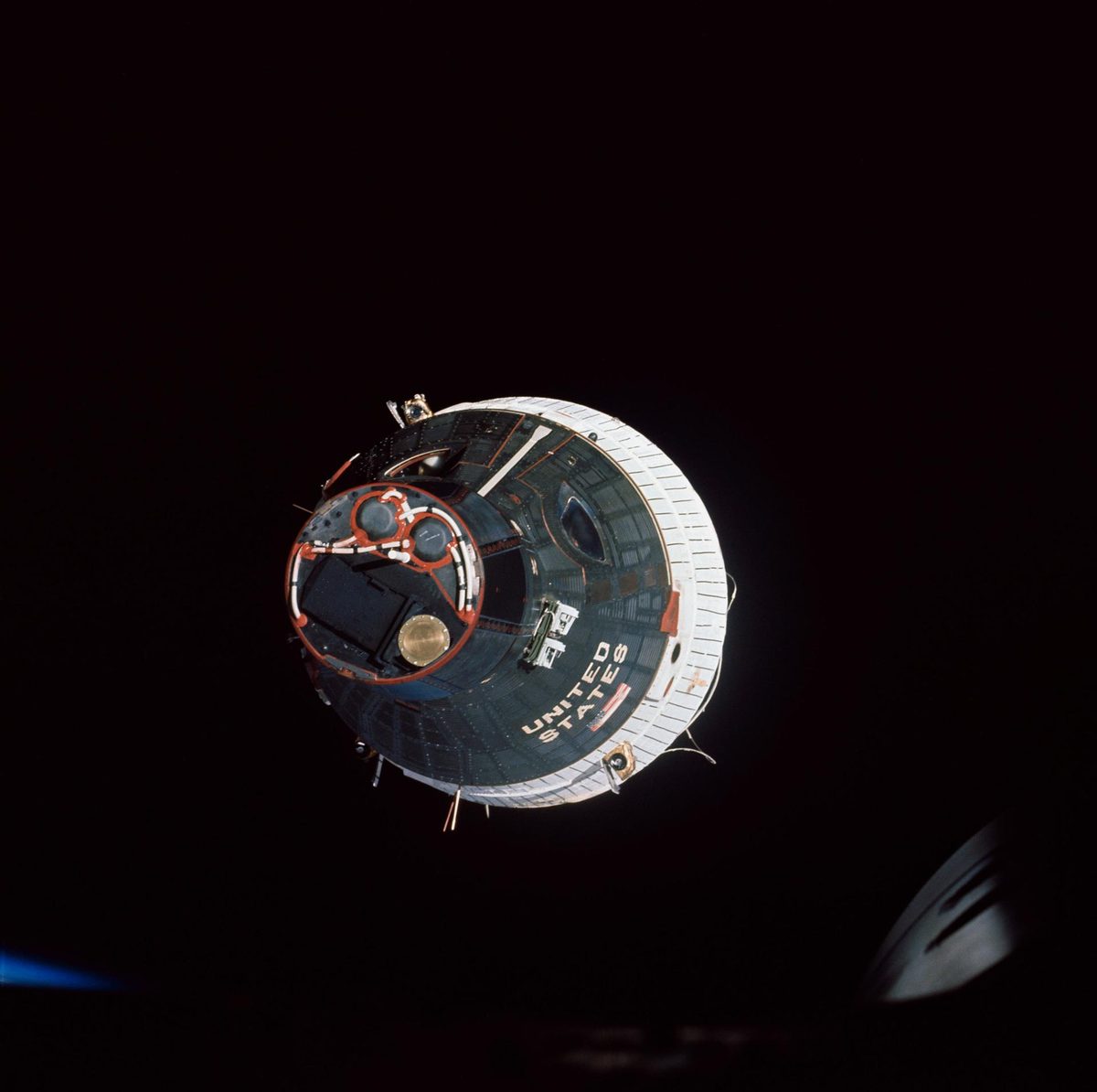
First RendezvousWally Schirra and Thomas Stafford. The first true orbital rendezvous: two crewed spacecraft brought to within one foot of each other and held there, station-keeping for more than five hours. They did not dock, neither vehicle had a docking port, but rendezvous was the hard part, and it was solved.
Rendezvous, not docking, was the part nobody knew how to do. Closing on a target in orbit is counter-intuitive: thrusting towards it raises your orbit, slows you down and makes the gap grow. Gemini 4 had tried exactly that a few months earlier and watched its target drift away.
16 Mar 1966
First DockingNeil Armstrong and David Scott. The first docking of two spacecraft in orbit, followed within half an hour by the first life-threatening emergency in flight. The detail is below; it is the reason this page exists.
A docked pair is one vehicle, with mass properties and control authority neither half had alone. The crew’s reasoning was sound for two separate spacecraft and wrong for the thing they were actually flying.
3 Jun 1966
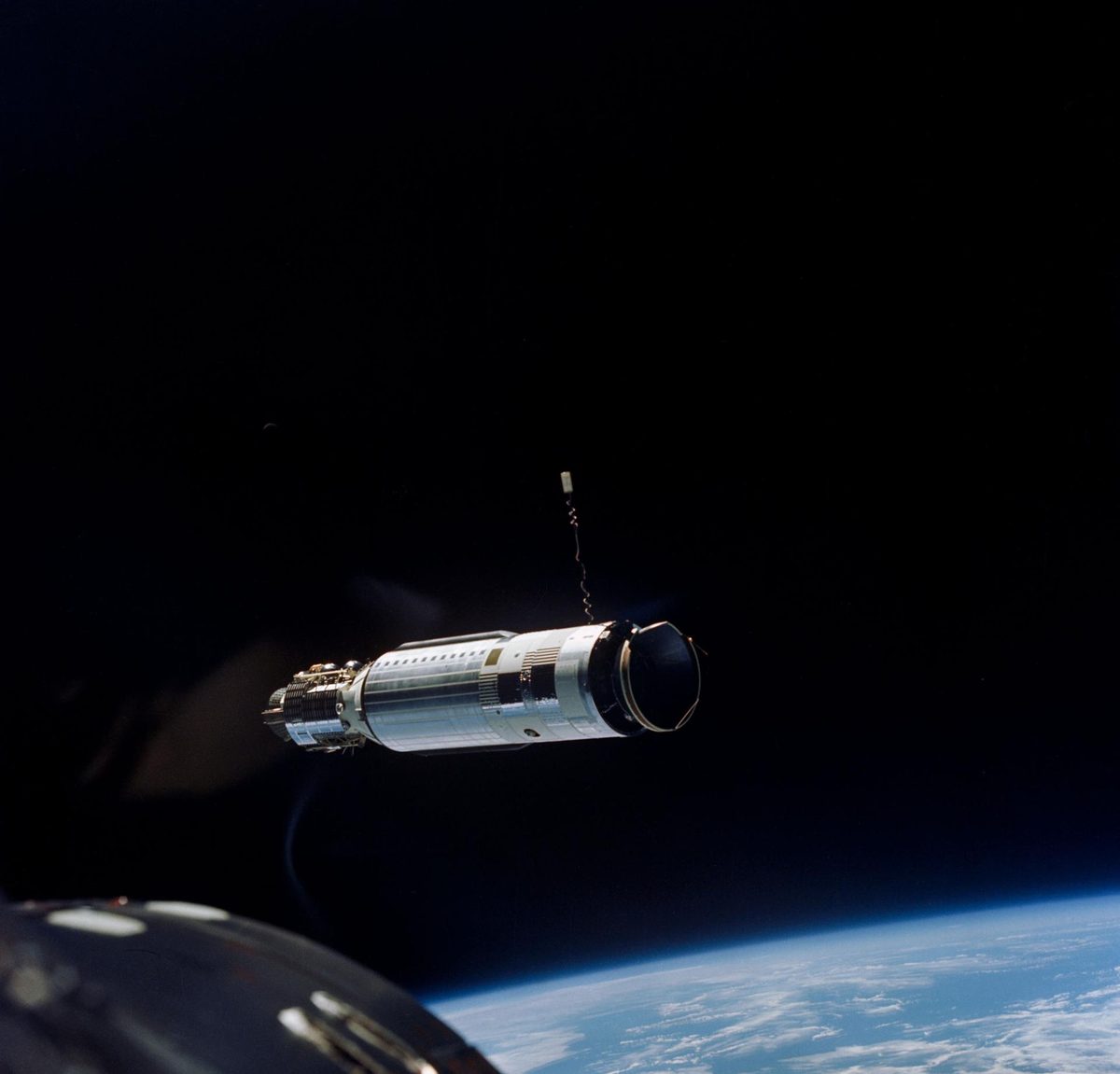
Target FailureThomas Stafford and Eugene Cernan. The target vehicle reached orbit with its launch shroud still attached, jaws half open. Stafford called it “an angry alligator”. Docking was impossible, so the crew flew three different rendezvous profiles instead. Cernan’s EVA ran to two hours and nearly ended in disaster when his visor fogged and he overheated with no way to cool down.
Three different rendezvous profiles flown against a target that could not be docked with turned a failed mission into the best rendezvous training of the programme.
18 Jul 1966
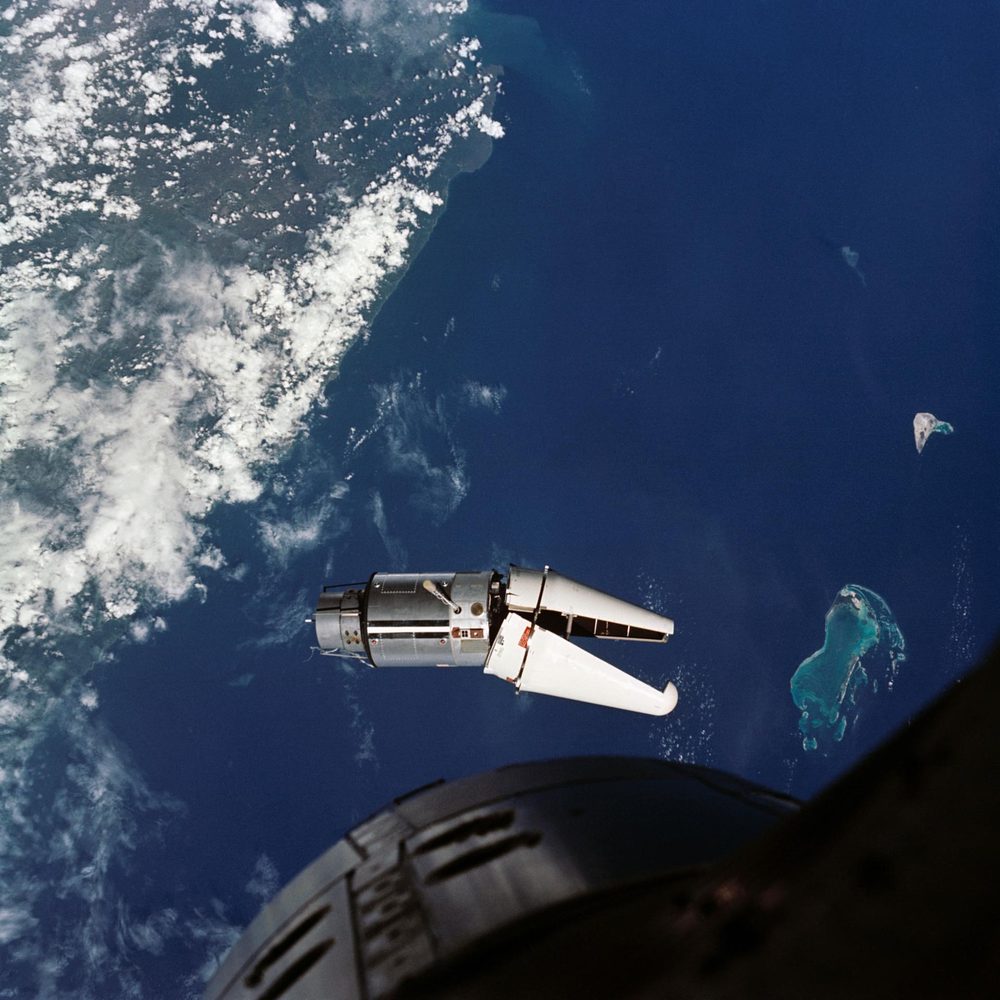
Dual RendezvousJohn Young and Michael Collins docked with their own Agena, used its engine to climb to a record altitude, then rendezvoused with the derelict Agena left by Gemini 8 , a dead target with no transponder, no lights and no attitude control. The first rendezvous with a genuinely uncooperative object.
Reaching the dead Agena left by Gemini 8, no transponder, no lights, no attitude control, was the first approach to a genuinely uncooperative object. Sixty years later that is still the frontier.
12 Sep 1966
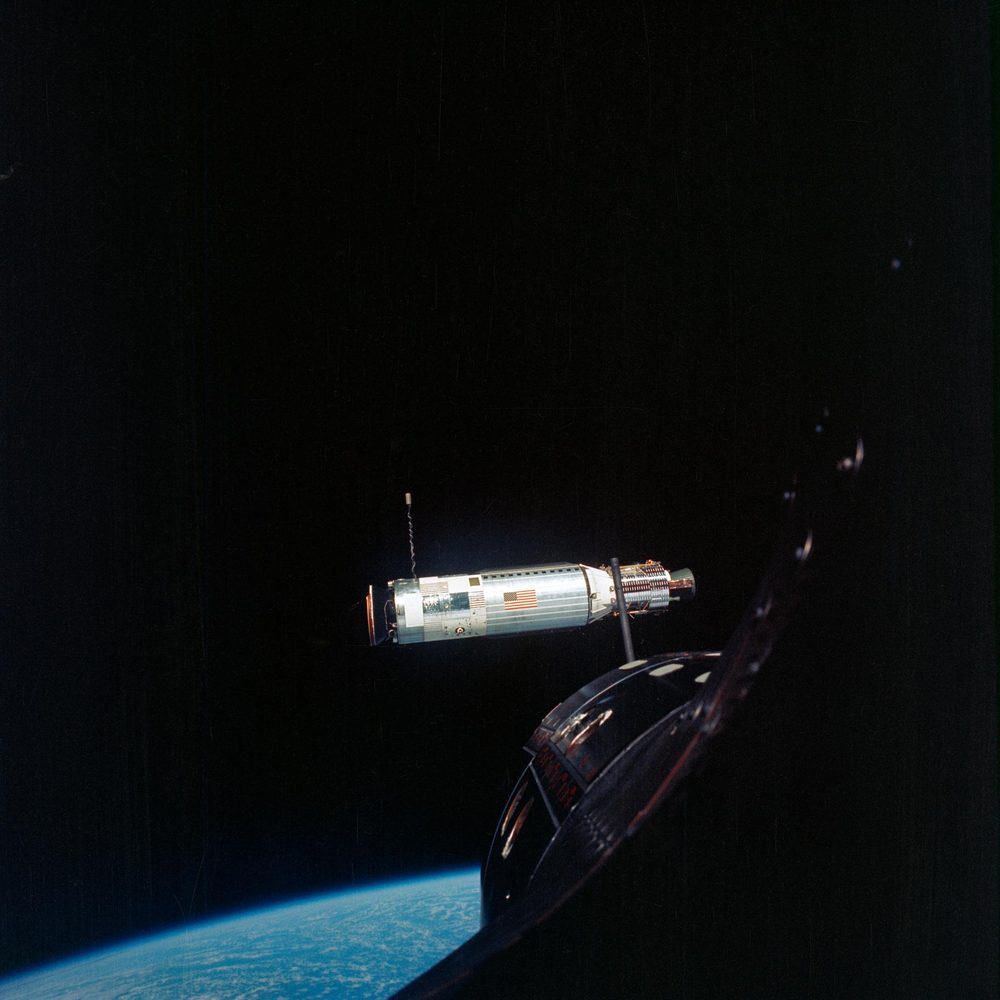
First-Orbit DockingCharles Conrad and Richard Gordon docked with their Agena on the first orbit, a direct-ascent rendezvous inside 94 minutes. They then used the Agena engine to reach 1,369 km, still the altitude record for a crewed spacecraft in Earth orbit.
A first-orbit rendezvous compresses every phasing decision into minutes. It existed to prove the direct-ascent profile a lunar ascent stage would need, where waiting is not an option.
11 Nov 1966
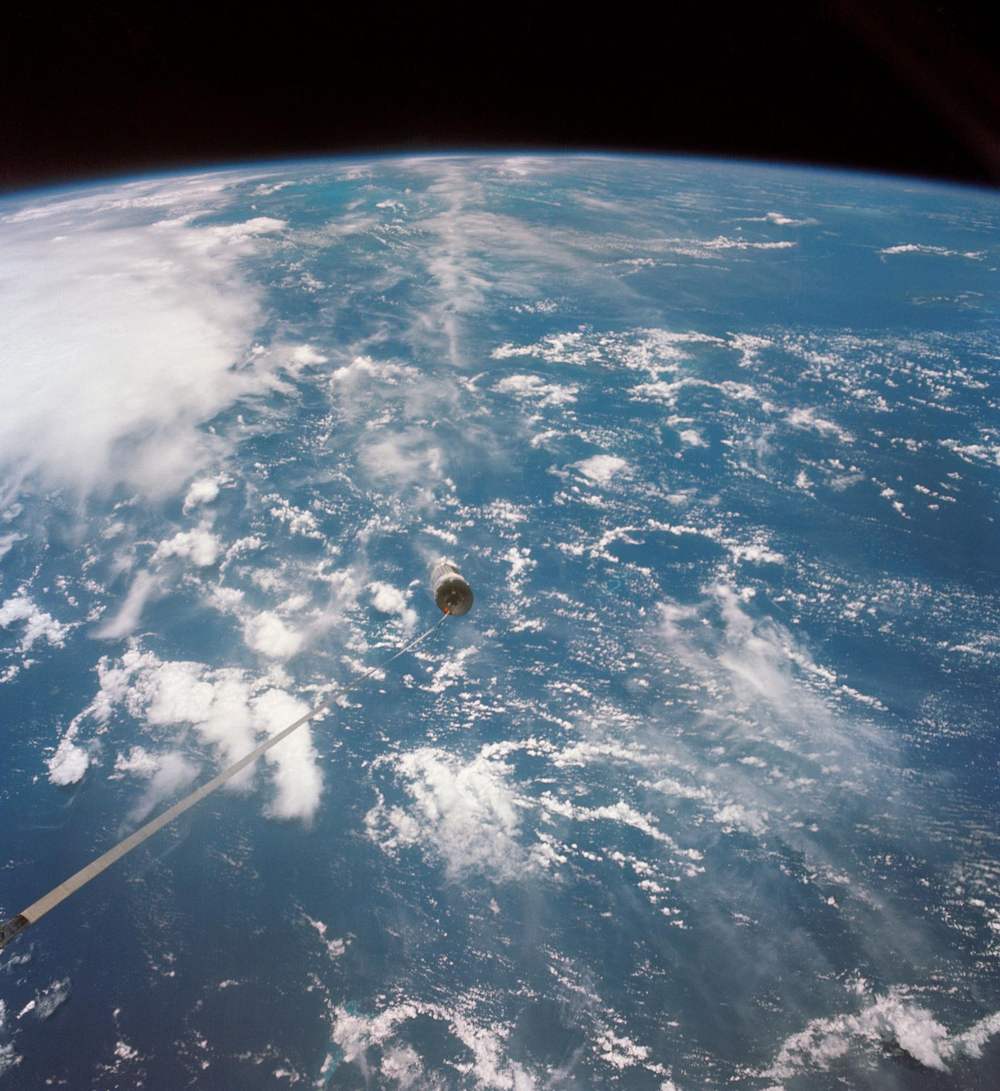
Eva SolvedJames Lovell and Edwin “Buzz” Aldrin. The radar failed during rendezvous, so Aldrin computed the closing manoeuvres by hand from a sextant and a chart, and they docked anyway. His five hours of EVA, worked out beforehand in a water tank with handrails and foot restraints, finally made spacewalking a controllable task rather than an exhausting fight.
The radar failure made the manual backup real rather than theoretical, and the underwater rehearsal turned EVA from an exhausting fight into a plannable job. Both lessons went straight into Apollo.
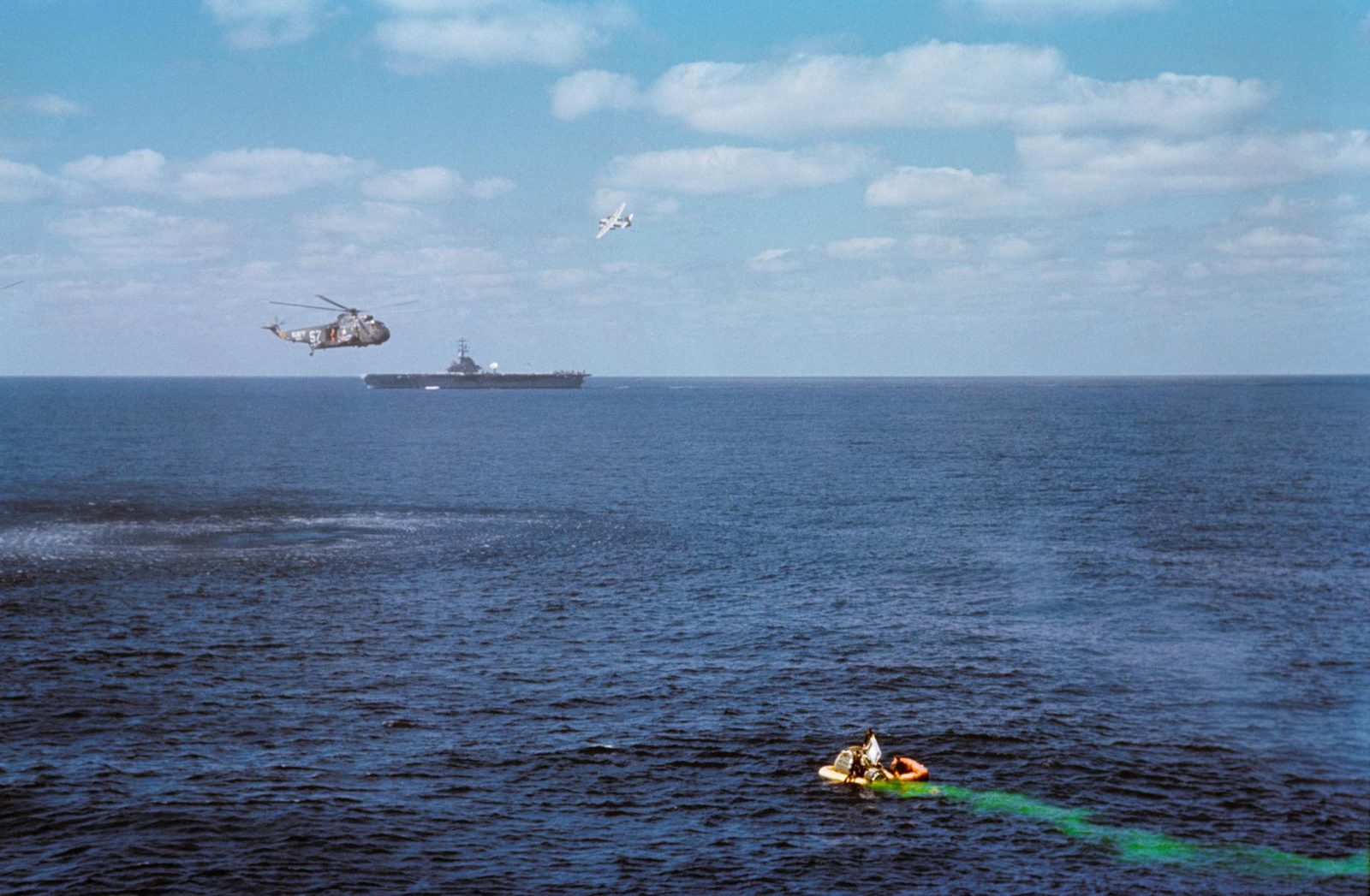
T minus 00:02:00 GEMINI VIII
On 16 March 1966, Neil Armstrong and David Scott docked with an Agena target vehicle. It was the first time two spacecraft had ever been joined in orbit. Twenty-seven minutes later they were spinning at roughly one revolution per second and losing their vision.
T + 6h 33m
Armstrong flies the final approach manually and the two vehicles latch together. Ground control, watching from Hawaii, confirms it. The crew are told the Agena has a known attitude-control fault and that they should turn it off if anything looks wrong.
T + 6h 47m
Scott notices the stack rolling. The obvious suspect is the Agena, whose control system has just run a stored command sequence. Armstrong counters with the Gemini’s own thrusters and the roll stops. Then it starts again.
T + 7h 00m
With propellant draining, they conclude the Agena is the problem and undock to get clear of it. The rate immediately gets worse. The fault was never in the Agena. A thruster on the Gemini had stuck open, and the mass of the docked Agena had been damping what it was doing. Undocking removed the damping.
T + 7h 17m
The spacecraft is tumbling fast enough that the crew’s vision blurs and they are close to losing consciousness. Armstrong shuts down the manoeuvring system entirely and brings the spacecraft under control using the re-entry thrusters, a separate system reserved for coming home.
T + 10h 41m
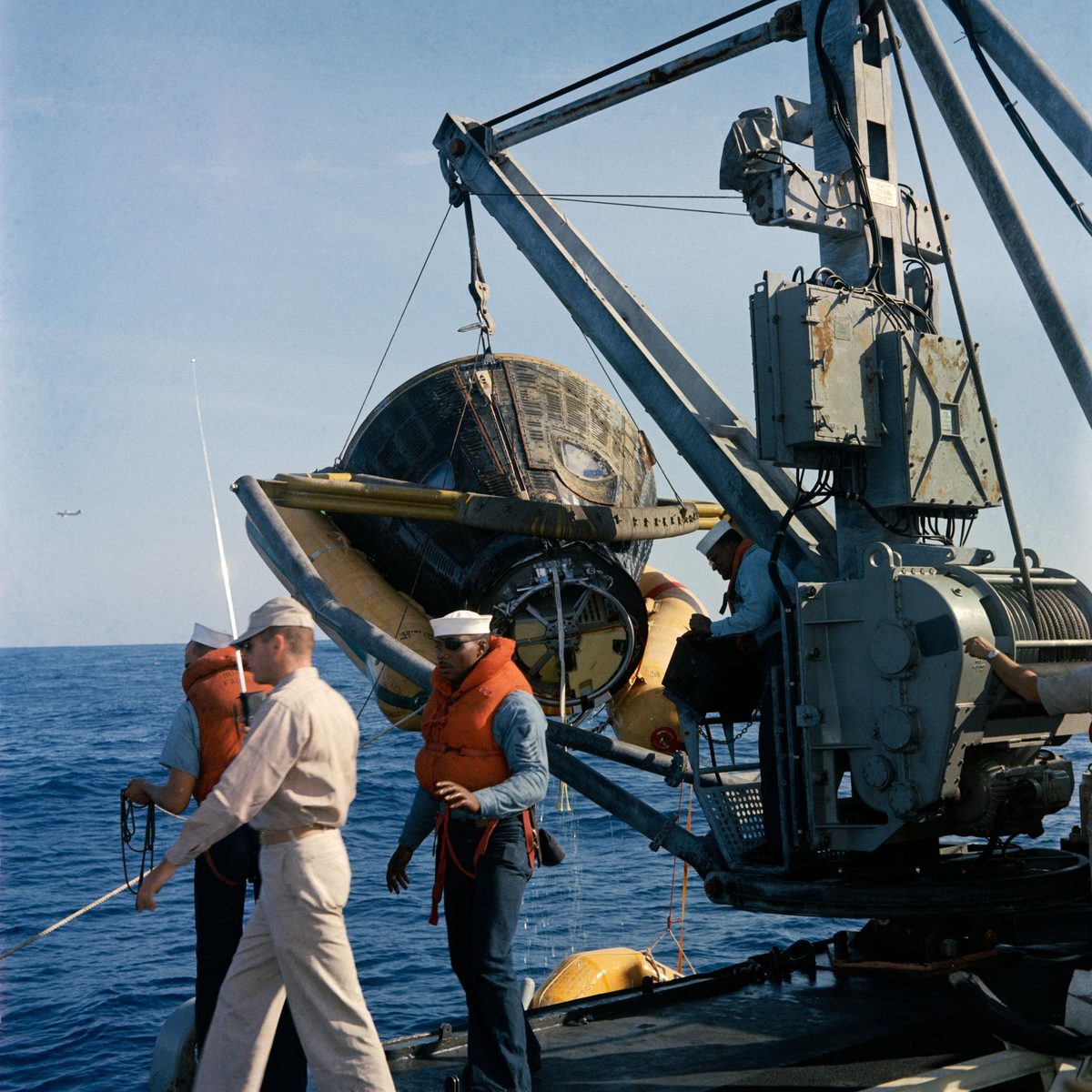
Mission rules were unambiguous: once the re-entry control system has been fired, you come home. They splashed down in the Pacific having flown less than a third of a three-day mission, and having completed its single most important objective.
Three things, and they have not aged.
A docked pair is one vehicle, not two. Mass properties, flexible modes and control authority all change the instant you latch. The crew’s reasoning was sound for two separate spacecraft and wrong for the thing they were actually flying.
Undocking is not a safe default. Separating from a suspected fault is the intuitive move, and here it made a survivable situation nearly fatal. Whether backing away is safe depends on where the fault actually is, which is exactly what you do not know at the time.
Diagnosis under time pressure is the hard part. The correct action, isolating the manoeuvring system, was available from the first moment. What was missing was any way to tell which of two coupled vehicles was misbehaving, quickly enough to matter.
Sixty years on, this is still the problem. An autonomous vehicle in close proximity has to decide, in seconds and without a ground loop, whether what it is seeing is its own fault or the target’s, and whether backing off helps or makes it worse.
T minus 00:01:00 WHAT CARRIED FORWARD
T minus 00:00:20 SOURCES
NASA, Gemini’s first docking turns to wild ride in orbit
Baker, David. The History of Manned Spaceflight. New York: Crown, 1981.
Yenne, Bill. The Encyclopedia of US Spacecraft. New York: Exeter, 1985.
Images courtesy of NASA. NASA still imagery is generally in the public domain.
What is counted: the twelve Gemini flights, judged on their primary objective. Gemini 8 is partial: the docking, the objective, succeeded, and the mission was then aborted. Gemini 9A is partial: the rendezvous worked three times over and the target could not be docked with.