Final Proximity Space Systems

Let’s Talk Space

11Lunar missions, 1959 to 2000

Getting there the first time:
the Moon, 1959 to 2000.

Forty years in which the Moon went from an unreachable light to a place people had walked on, and then, for almost two decades, to somewhere nobody bothered to go.

T minus 00:10:00   THE SHAPE OF IT

Three phases, and a long silence

Lunar exploration in this period divides cleanly. A decade of reaching, from 1959 to 1966, in which most attempts failed and each success was a first. A decade of arriving, from 1966 to 1976, which produced every crewed landing and every sample returned. Then nothing at all from 1976 to 1990, the longest gap in the history of lunar exploration.

The failure rate in the first phase is worth holding on to, because it recurs in the modern era and for much the same reasons. Of the first twenty Soviet and American attempts to reach the Moon, fewer than a quarter did what they set out to do.

18missions listed
13success
4partial
1failed
72%fully successful

T minus 00:08:30   REACHING

Getting there at all, 1959 to 1966

Both programmes lost far more vehicles than they landed. Most failures were launch vehicles and trajectory errors rather than anything at the Moon itself.

Jan 1959

missed, first to solar orbit

Luna 1failed

Missed the Moon by about 6,000 km after a guidance error, and became the first spacecraft to reach solar orbit. The intended mission was an impact.

A small pointing error at injection becomes thousands of kilometres at the Moon, and nothing on board could take it out again. Mid-course correction exists because injection accuracy alone was never going to be enough.

NSSDC, Luna 1

Sep 1959

first to reach another world

Luna 2landed

The first human object to reach another world, striking the surface near Mare Imbrium. Deliberately a hard impact: nothing yet existed that could slow down.

Hitting the Moon meant solving translunar navigation end to end, with tracking and timing good enough that a target under 3,500 km across was not missed. Arrival was confirmed by the transmissions stopping at the predicted second.

NSSDC, Luna 2

Oct 1959

first view of the far side

Luna 3landed

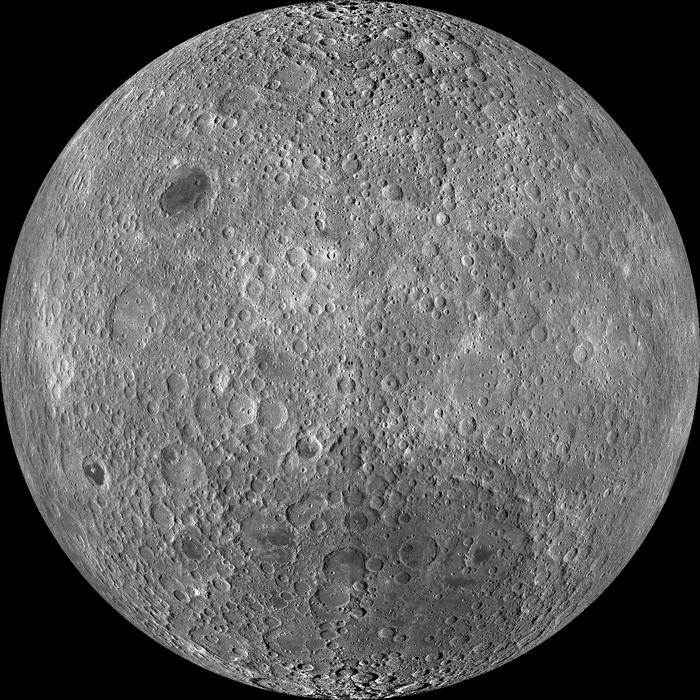
Photographed the far side of the Moon for the first time, developed the film on board, scanned it and radioed it home. Nobody had ever seen that hemisphere.

An entire imaging chain, exposure, film development, scanning and transmission, ran automatically in one vehicle in 1959. The trajectory was itself an early gravity assist, using the lunar pass to swing the spacecraft back over the northern hemisphere for downlink.
NSSDC, Luna 3

The far side Luna 3 first glimpsed, here in the LRO camera mosaic. The 1959 photograph itself is Soviet and cannot be reproduced. NASA/Goddard/Arizona State University.

1961 to 1965

first close images

Ranger 1 to 9partial

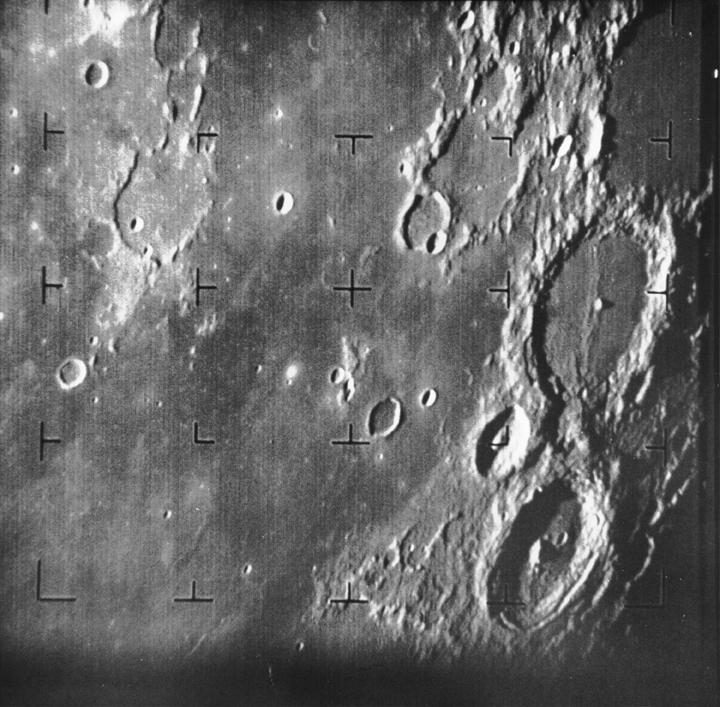
Nine American impact probes. The first six failed outright. Rangers 7, 8 and 9 returned thousands of images during their final minutes, each one closer than the last, and settled that the surface was firm enough to land on.

Six consecutive failures bought the redundancy rules, the test discipline and the failure review culture that the last three flights flew with. The turnaround was process, not luck.
NSSDC, Ranger 7

Ranger 7’s first image of the Moon, about seventeen minutes before impact, the first close photograph an American spacecraft returned. NASA/JPL, PIA02975.

Feb 1966

first soft landing

Luna 9landed

The first soft landing on another world. It used an airbag-cushioned capsule ejected before impact rather than a controlled descent, and returned panoramas from the surface that ended a long argument about whether a lander would sink into deep dust.

The airbag capsule sidestepped the hardest part of landing, the final metre, by making the payload survivable rather than the descent perfect. Decoupling touchdown survival from guidance precision is a trade Mars Pathfinder repeated three decades later.

NSSDC, Luna 9

1966 to 1968

controlled descent proven

Surveyor 1 to 7partial

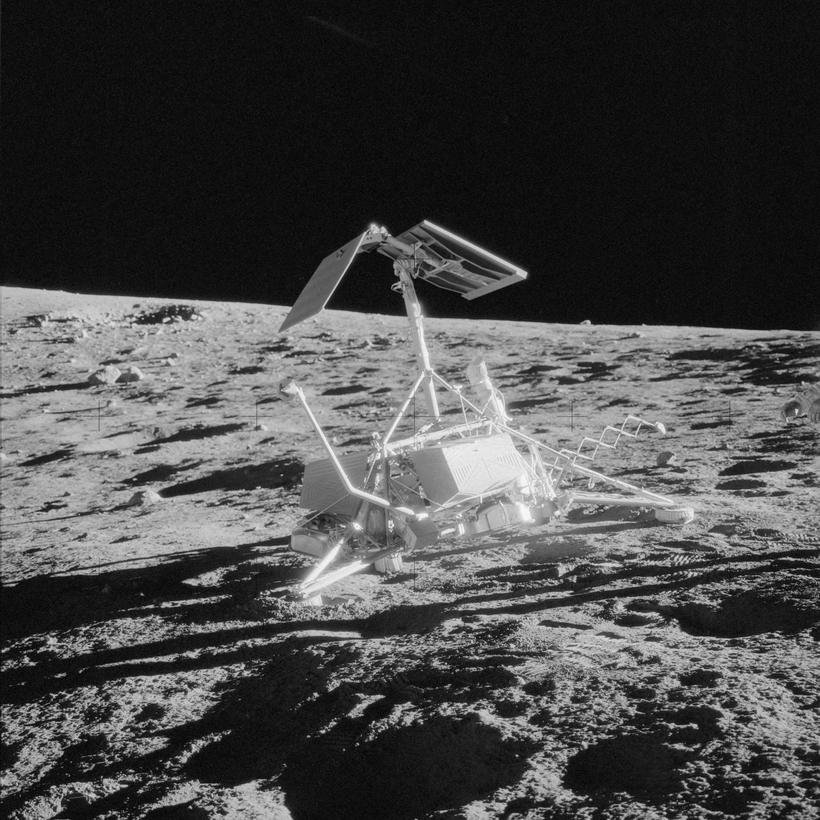
Seven American landers flying genuine controlled descent with a radar altimeter and a throttleable engine. Five succeeded. Surveyor 3 was later visited by the Apollo 12 crew, who cut pieces off it and brought them home to see what two and a half years on the surface had done.

Closed-loop throttled descent on radar altimetry is the control problem every modern lander still flies, first solved here. The pieces Apollo 12’s crew brought back gave something unique, ground truth for what years of surface exposure do to hardware.
NSSDC, Surveyor 1

Surveyor 3 standing in its crater, photographed by the Apollo 12 crew two and a half years after it landed. NASA, as12-48-7121.

1966 to 1967

the landing sites mapped

Lunar Orbiter 1 to 5landed

Five orbiters that mapped almost the entire surface to find and certify the Apollo landing sites. All five worked, which for the period is remarkable.

Tracking these orbiters revealed mascons, buried mass concentrations that perturb low lunar orbits strongly enough that every mission since has had to model them. The mapping was the objective; the gravity field was the lasting discovery.
NSSDC, Lunar Orbiter 1

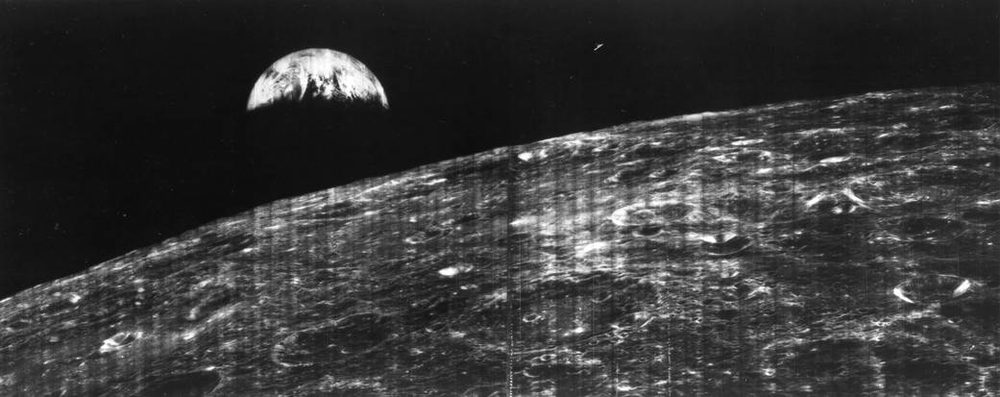
Lunar Orbiter 1’s 1966 view of Earth over the Moon, the first ever taken, in the original scan strips. NASA.

T minus 00:06:30   ARRIVING

People, and samples, 1968 to 1976

The crewed landings and the robotic sample returns happened in the same eight years, by two programmes that were racing and largely ignoring each other.

Dec 1968

first crew to leave Earth orbit

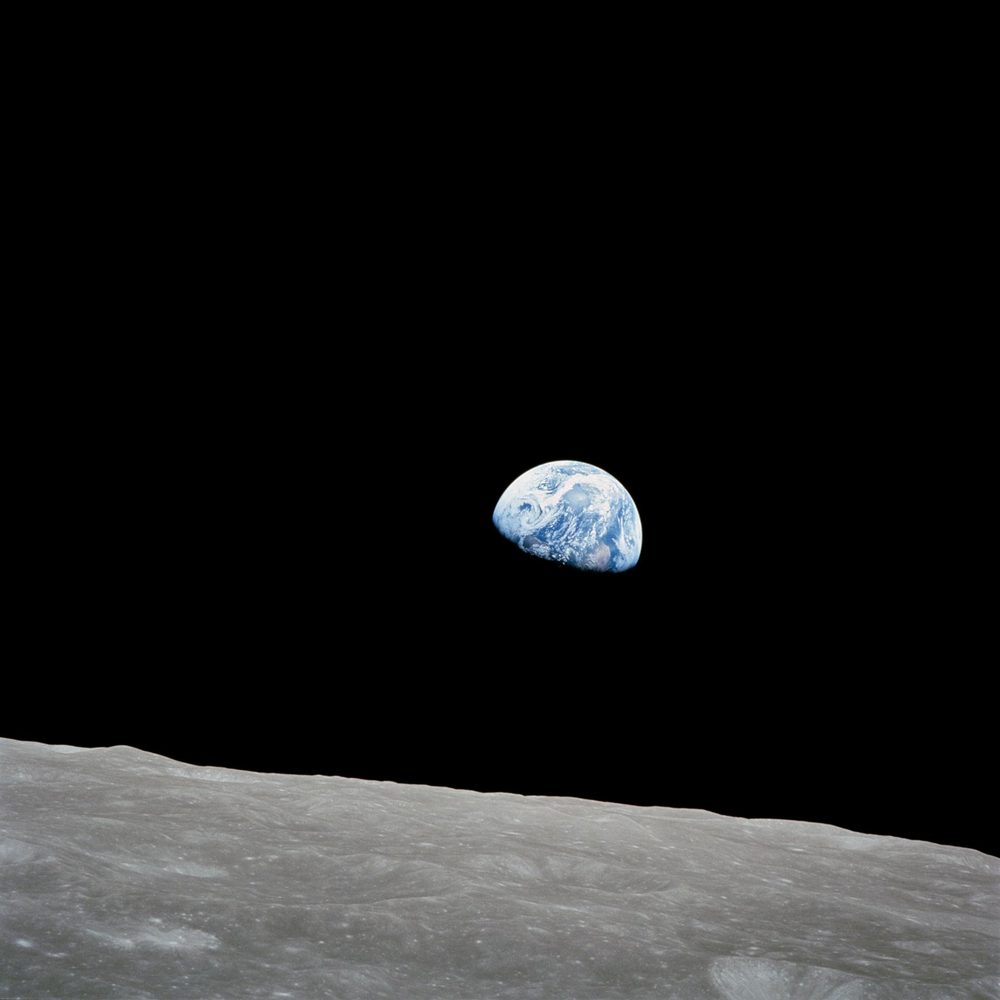
Apollo 8landed

The first crew to leave Earth orbit and the first to orbit the Moon. Flown on a decision taken only months earlier, because the lunar module was not ready and the schedule was.

Flying the mission before the lander existed decoupled the programme’s two hardest developments and let each be proven separately. It also meant the first trans-Earth injection by a crew, behind the Moon, out of contact, on one engine with no backup.

NSSDC, Apollo 8

Earthrise, December 1968. NASA, as08-14-2383.

Jul 1969

first landing

Apollo 11landed

The first landing. The guidance computer overloaded during descent and raised program alarms, and Armstrong flew the last part manually past a boulder field, touching down with seconds of propellant margin. A precision landing it was not.

The 1202 alarms were the computer shedding low-priority work under overload, exactly as its executive was designed to do. Graceful degradation under load, built in years earlier, is why the landing could continue.

NSSDC, Apollo 11

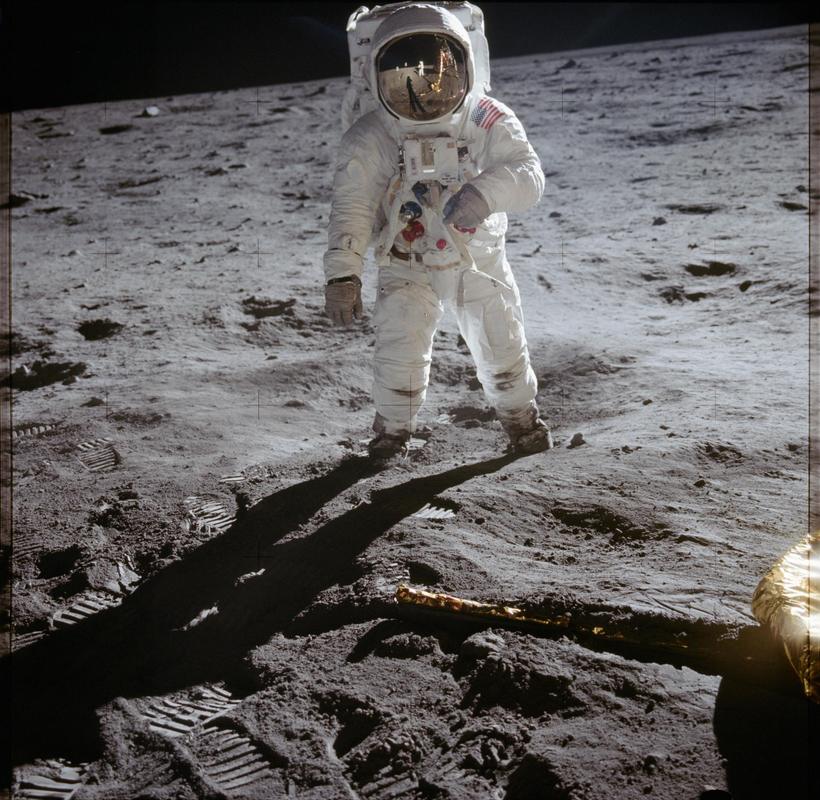
Aldrin at Tranquility Base. NASA, as11-40-5903.

Nov 1969

first precision landing

Apollo 12landed

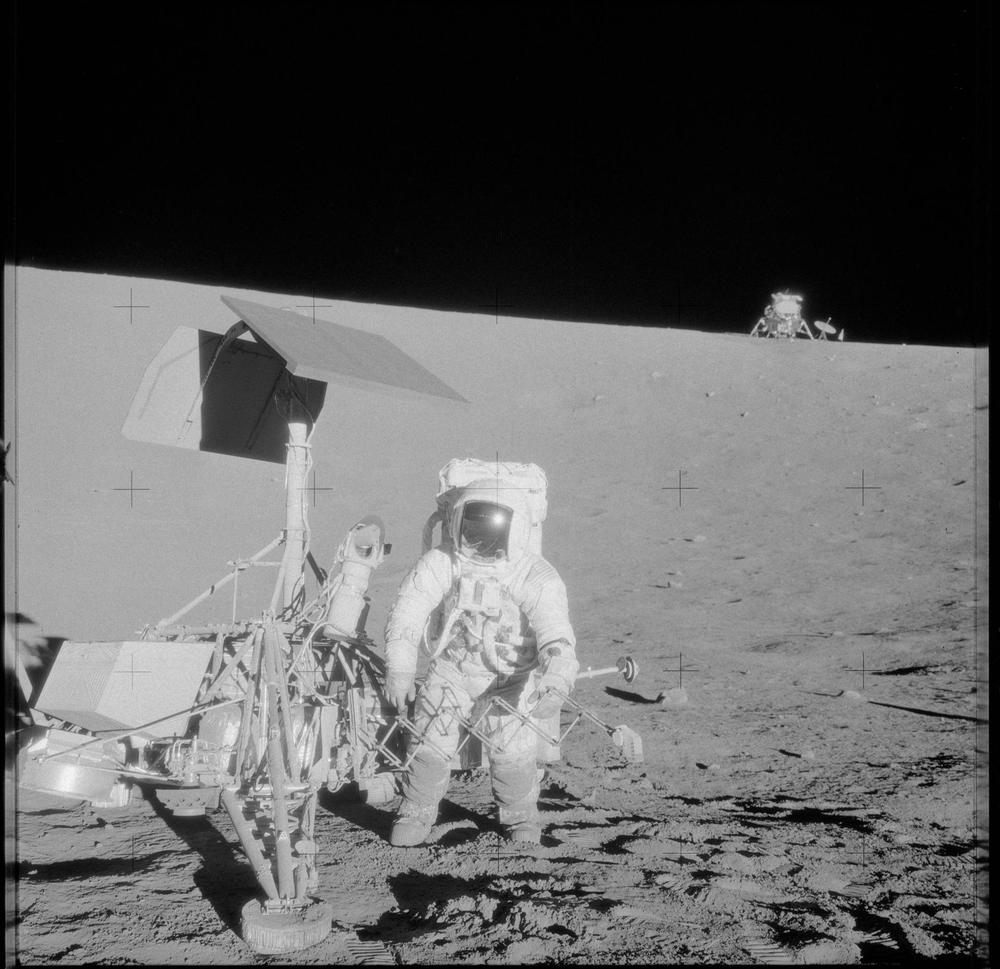
Landed within about 160 metres of Surveyor 3, which was the actual objective: proving that a specific spot could be reached rather than a general area. Precision landing starts here.

Point targeting is what everything later depends on, because a base, a resource deposit or a stranded spacecraft is a spot rather than a region. The fix was navigational, correcting for the gravity anomalies that had pushed Apollo 11 long.

NSSDC, Apollo 12

Conrad examining Surveyor 3, the lunar module Intrepid on the horizon. The photograph is the proof of the precision landing. NASA, as12-48-7136.

Apr 1970

the landing that became a rescue

Apollo 13partial

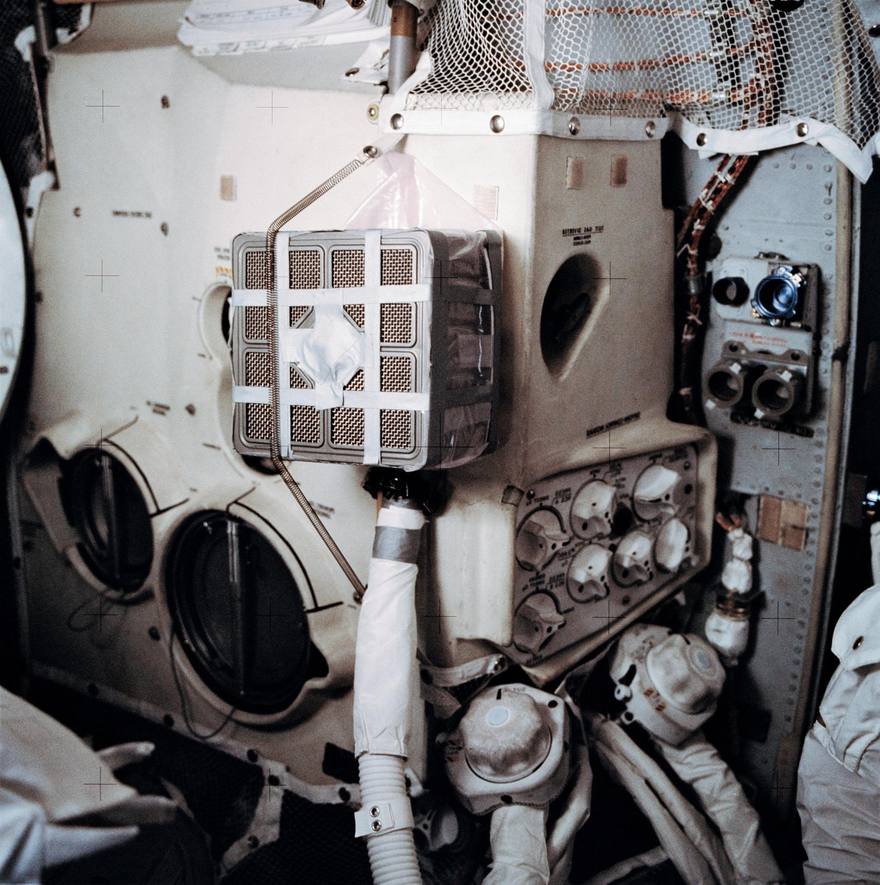
An oxygen tank ruptured on the way out. The landing was abandoned and the lunar module used as a lifeboat, which it had never been designed for. The crew came home.

Survival came from margin used in ways nobody planned, a two-person, two-day vehicle stretched to three people for four days, with consumables engineering done live on the ground. Margin does not care what it was originally for.

NSSDC, Apollo 13

The improvised lithium hydroxide adapter aboard the lunar module, built from a flight plan cover, a sock and tape, to the ground’s instructions. NASA, as13-62-8929.

Sep 1970

missed, first to solar orbit

Luna 16landed

The first robotic sample return from another world. Drilled, sealed and launched about 100 grams back to Earth with no crew involved anywhere in the chain.

Automating the full chain, landing, drilling, sealing, ascent and re-entry, solved in miniature everything Apollo did with crew aboard. The hundred grams mattered less than proving sample return scales down.

NSSDC, Luna 16

Nov 1970

first rover on another world

Lunokhod 1landed

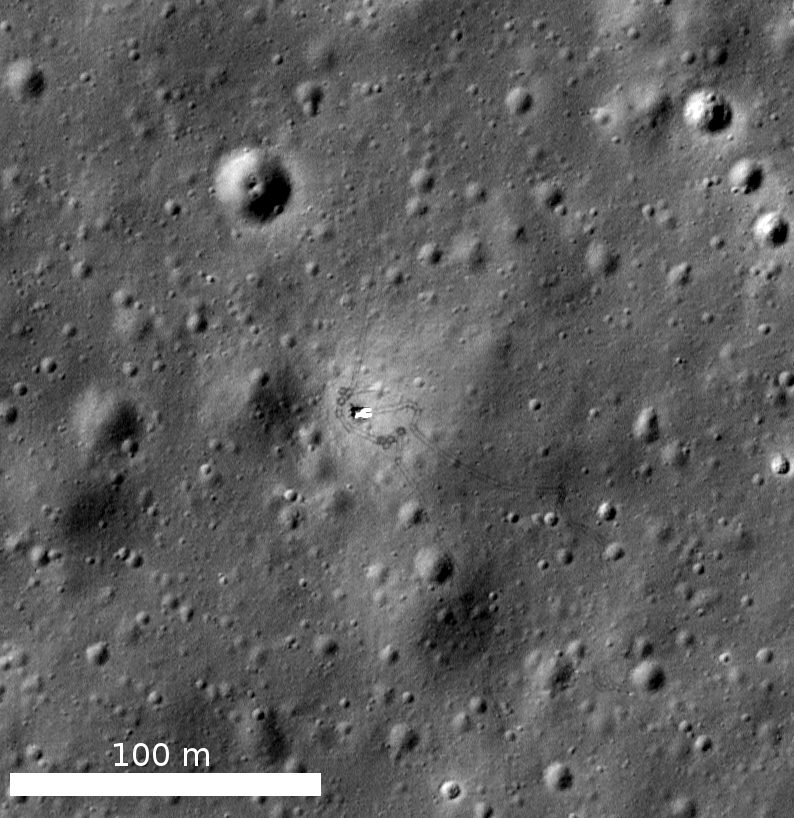
The first rover on another world, driven from Earth by a five-person team working with a several-second control delay and a slow-scan television picture. It ran for eleven months.

Teleoperation with seconds of delay is not driving but prediction, commanding what should be true when the signal arrives. Every planetary rover since has moved the same way, with longer delays and more autonomy in between.

NSSDC, Luna 17 and Lunokhod 1

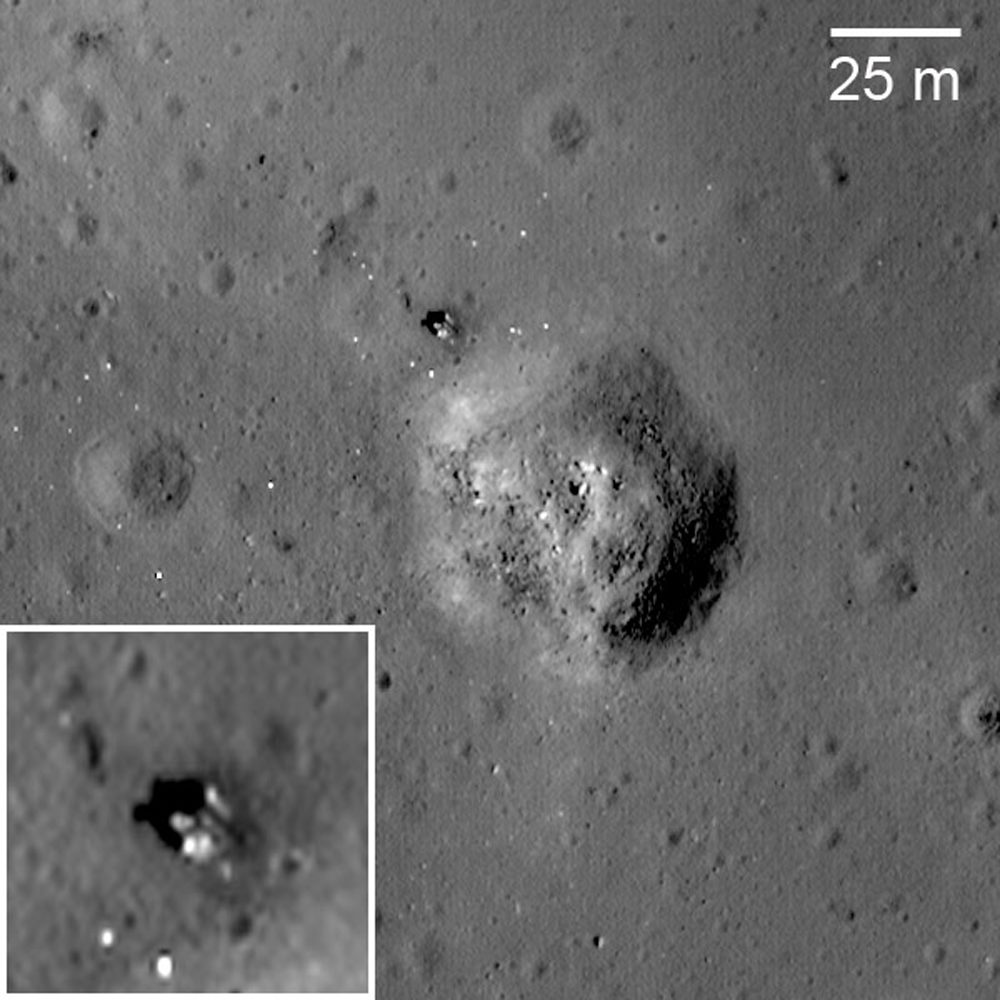
The Luna 17 lander, bright, and Lunokhod 1’s looping wheel tracks, still crisp when LRO photographed them four decades on. NASA/GSFC/Arizona State University.

1971 to 1972

the last crews

Apollo 14 to 17landed

Progressively longer stays, a rover from Apollo 15, and a professional geologist on the final flight. Apollo 17 left in December 1972 and nobody has been back.

Each flight extended stay, range and payload on essentially the same hardware, which is what a maturing system looks like. The marginal cost of capability was falling when the programme was cancelled anyway.

NASA History, Apollo

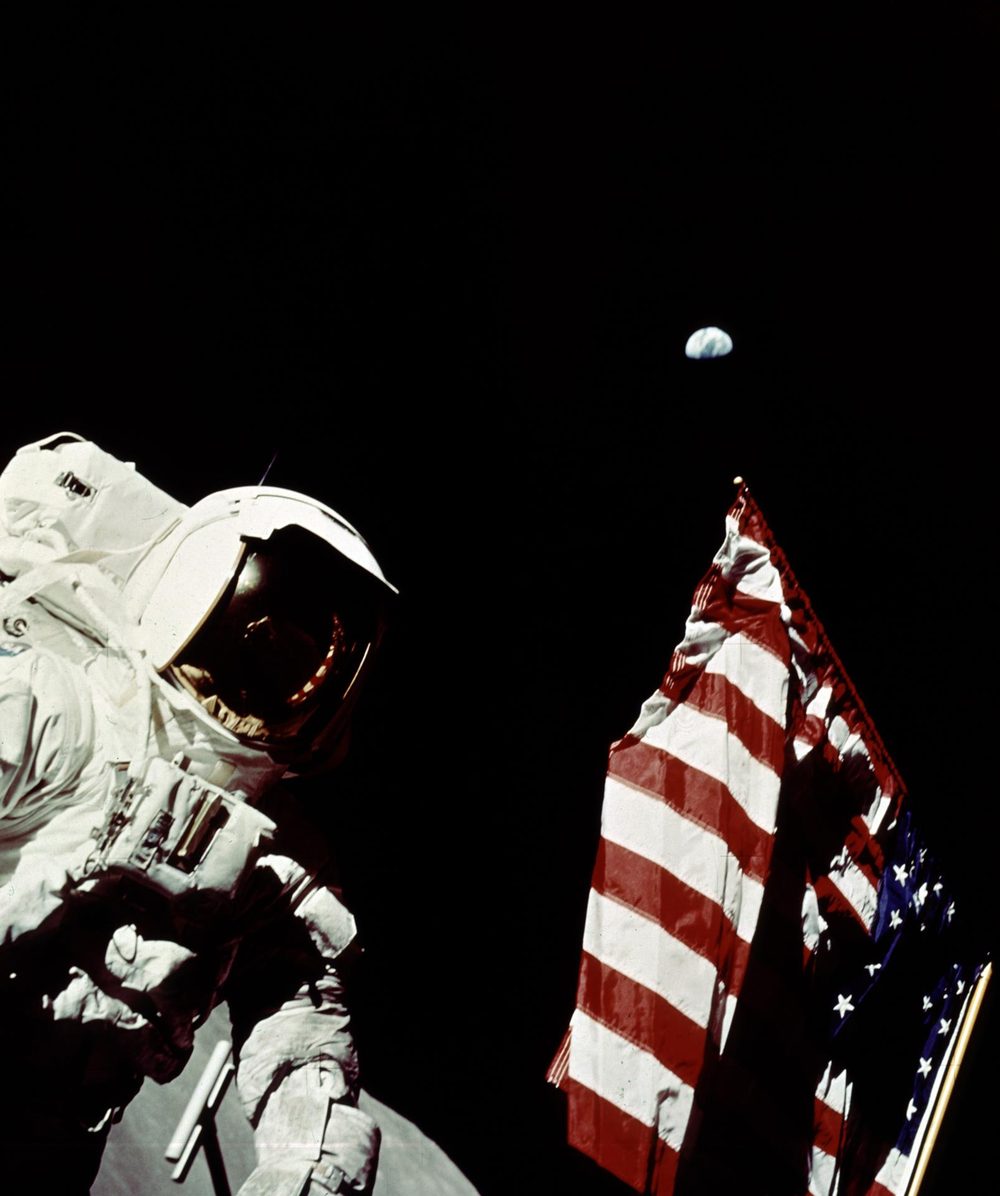
An Apollo 17 astronaut at the flag, Earth overhead, Taurus-Littrow. The last crew on the Moon. NASA.

Aug 1976

first to reach another world

Luna 24landed

The last soft landing on the Moon by anyone for thirty-seven years. It returned 170 grams of core sample and then the programme stopped.

Its core held bound water that went largely unremarked for decades, until orbital detections sent researchers back to the archive. Data can outlive the programme that collected it, and the interest of its era.

NSSDC, Luna 24

The Luna 24 descent stage on its crater-rim ejecta in Mare Crisium, seen from lunar orbit by LRO. Soviet surface imagery cannot be reproduced. NASA/GSFC/Arizona State University.

T minus 00:04:00   THE GAP

Nothing, 1976 to 1990

For fourteen years no spacecraft was sent to the Moon by anyone. The capability was not lost so much as set down, and picking it up again turned out to be harder than expected.

1976 to 1990

the fourteen year gap

No missions

Both programmes had achieved what they were funded for and neither had a reason to continue. The engineers who had flown these missions moved on or retired, and the specific knowledge of how to land on the Moon stopped being a live skill and became a historical record.

Capability lives in people and current practice rather than in documents, and when the teams dispersed the ability to land went with them. Every programme since has paid the relearning cost, which is the strongest argument for continuity there is.

NSSDC, Lunar exploration timeline

Jan 1990

third nation to the Moon

Hitenpartial

Japan became the third nation to reach the Moon, with a small technology demonstrator using aerobraking and a novel low-energy transfer. Its sub-probe Hagoromo failed on release, but the trajectory work it proved is still used.

The ballistic capture route through the region where Earth, Moon and Sun gravity nearly balance trades months of transit for almost no insertion burn. Worked out to rescue this mission, the technique later flew operationally on GRAIL.

NSSDC, Hiten

Jan 1994

the hint of polar ice

Clementinelanded

A joint US Department of Defense and NASA mission that mapped the Moon in multiple wavelengths and returned the first hint of possible ice at the poles. It failed later while departing for an asteroid.

A sensor demonstrator doing planetary science on existing parts established the fast and cheap model of mission building. The ice hint came from an improvised bistatic radar experiment, using the communications transmitter as the instrument.

NSSDC, Clementine

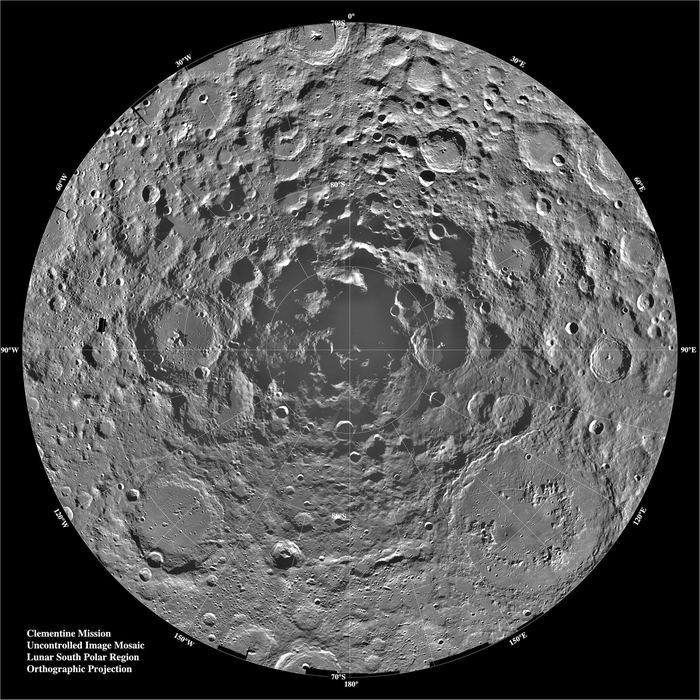
Clementine’s south pole mosaic, assembled from about 1,500 frames. NASA/JPL/USGS, PIA00001.

Jan 1998

hydrogen at both poles

Lunar Prospectorlanded

Found strong evidence of hydrogen at both poles, which reopened the question of water ice and, with it, the argument for going back at all. It was deliberately crashed into a polar crater in 1999 to look for a water plume, and none was detected.

Neutron spectroscopy senses hydrogen from orbit because hydrogen is uniquely effective at slowing the neutrons that cosmic rays knock out of the regolith. The measurement that reopened lunar exploration never touched the surface.

NSSDC, Lunar Prospector

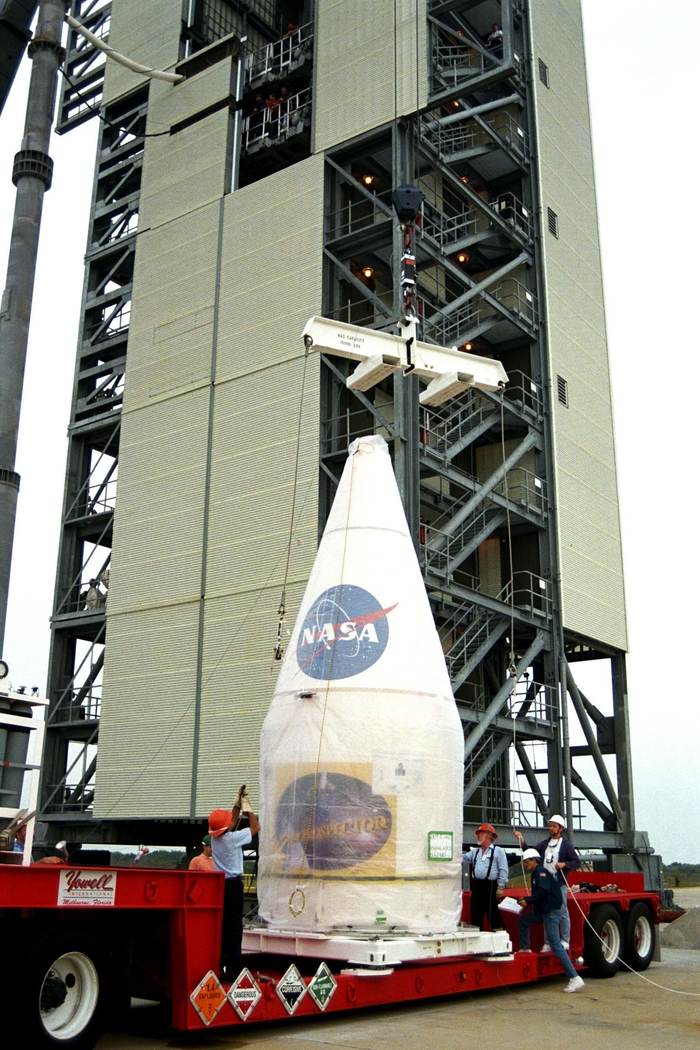
Lunar Prospector, sealed in its shroud, hoisted for mating to its launch vehicle in 1997. NASA, KSC-97PC1828.

T minus 00:00:40   WHAT IT LEFT

What the first era actually established

Solved

  • The surface bears weight. Settled by Luna 9 and confirmed by Surveyor.
  • Controlled descent works. Surveyor flew radar-guided throttled landings from 1966.
  • Lunar orbit rendezvous. Apollo proved the whole architecture, twice per mission.
  • Sample return without a crew. Luna 16, 20 and 24.

Left open

  • Precision. Apollo 11 landed kilometres long. Apollo 12 fixed that by hand, not by algorithm.
  • Hazard avoidance. Armstrong did it by looking out of the window.
  • Autonomy. Every landing had a person in the loop or a very simple radar law.
  • Doing it cheaply. The entire era ran on national budgets that no longer exist.

The gap matters more than it looks. When missions resumed after 2000 it was with new teams, new hardware and new software, and the landing problem had to be solved again from something close to first principles. What happened next is topic 12, and it is not a story of steady progress.

T minus 00:00:20   SOURCES

Where this comes from

NASA Space Science Data Coordinated Archive, Lunar exploration timeline

NASA History, Apollo programme

NASA Space Science Data Coordinated Archive, Luna 9

Compton, William David. Where No Man Has Gone Before: A History of Apollo Lunar Exploration Missions. NASA SP-4214, 1989.

How the outcomes are marked

success
The mission achieved its primary objective. The spacecraft arrived, the instruments worked, and the data or the crew came home. Judged against the mission’s own stated objective, not against later ambitions: Voyager 2 at Neptune, Chang’e 5 returning its sample, Apollo 11 despite landing long of its target.
partial
The mission reached its target and returned something real, but not everything it was built for: an instrument that failed after arrival, a lander that tipped, an antenna that never opened. Galileo delivered eight years of science through a jammed antenna. SLIM landed on its nose with its precision objective met. Philae bounced twice and still worked from shadow.
failed
The mission did not achieve its primary objective: it never arrived, it crashed, or it arrived unable to work. DART colliding with the satellite it came to inspect, Luna 25 into the surface, IM-2 on its side in shadow with no power and none of its science.

What is counted: the missions listed here, judged on their own primary objective. Luna 1 is marked failed because it was meant to strike the Moon and missed. Apollo 13 is failed against its objective, which was a landing, and remains one of the great feats of improvisation. The Ranger and Surveyor entries each cover a whole series in which some flights failed and some succeeded.

All nine topics
PreviousChronology of flyby missions NextLunar missions, 2000 to today