 Final Proximity
14Dynamic test benches: floating the spacecraft
Dynamics you cannot
argue With.
Air bearings float the vehicle on microns of gas and the physics is real: push it and it drifts forever, touch it and the contact forces are true. The question is how many degrees of freedom you can buy.
T minus 00:08:00 THE IDEA
Three, five, six: what the degrees of freedom cost
A planar air-bearing vehicle floats on a film of gas over a flat floor: two translations and one rotation, genuinely frictionless, which is 3-DoF. Put the payload on a spherical air bearing atop the planar one and it also pitches and rolls: 5-DoF. The sixth degree, sustained free vertical motion, is the expensive one, bought with counterweights, vertical air bearings or clever suspension, and every solution contaminates the very dynamics it enables.
The trade against the kinematic hall is exact: here the dynamics are real and unarguable, contact is honest, fuel consumption is honest, but the orbit is gone; a flat floor has no gravity gradient and no curvature. The two families test different halves of the same problem.
Flat floor
NASA · MarshallThe granite tradition
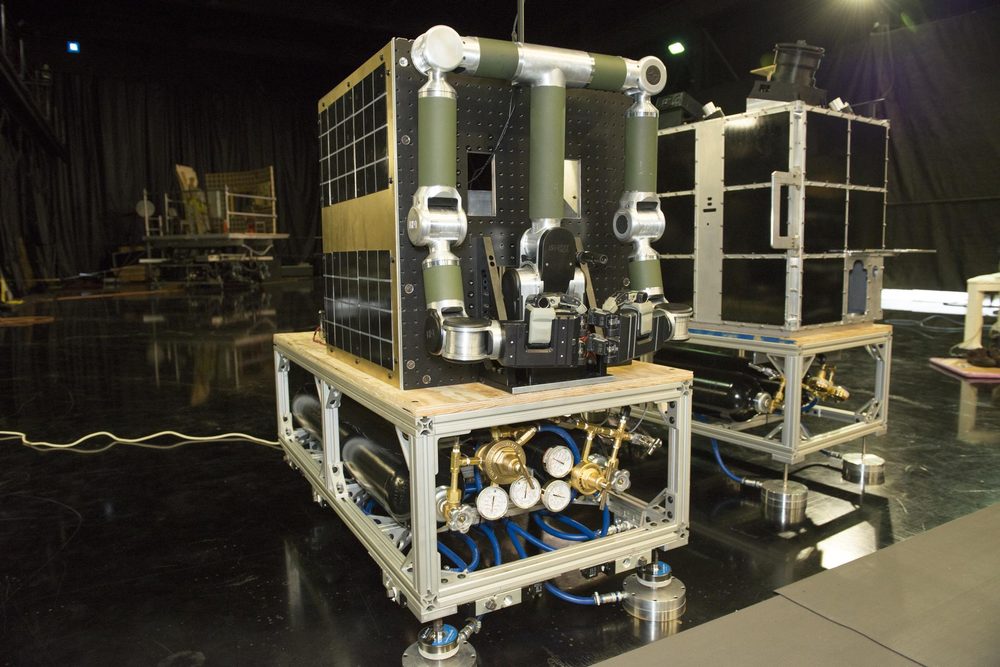
Marshall’s flight robotics floor is the old master of the family: air-bearing sleds carrying arms, sensors and docking hardware across a polished expanse, rehearsing captures with real contact dynamics since the Shuttle era.
Flatness is the whole engineering: a floor that undulates by a tenth of a millimetre applies phantom forces to every vehicle on it, and the floor is therefore the most precise object in the building.
TEAMS
DLR · BremenTwo floors, two scales
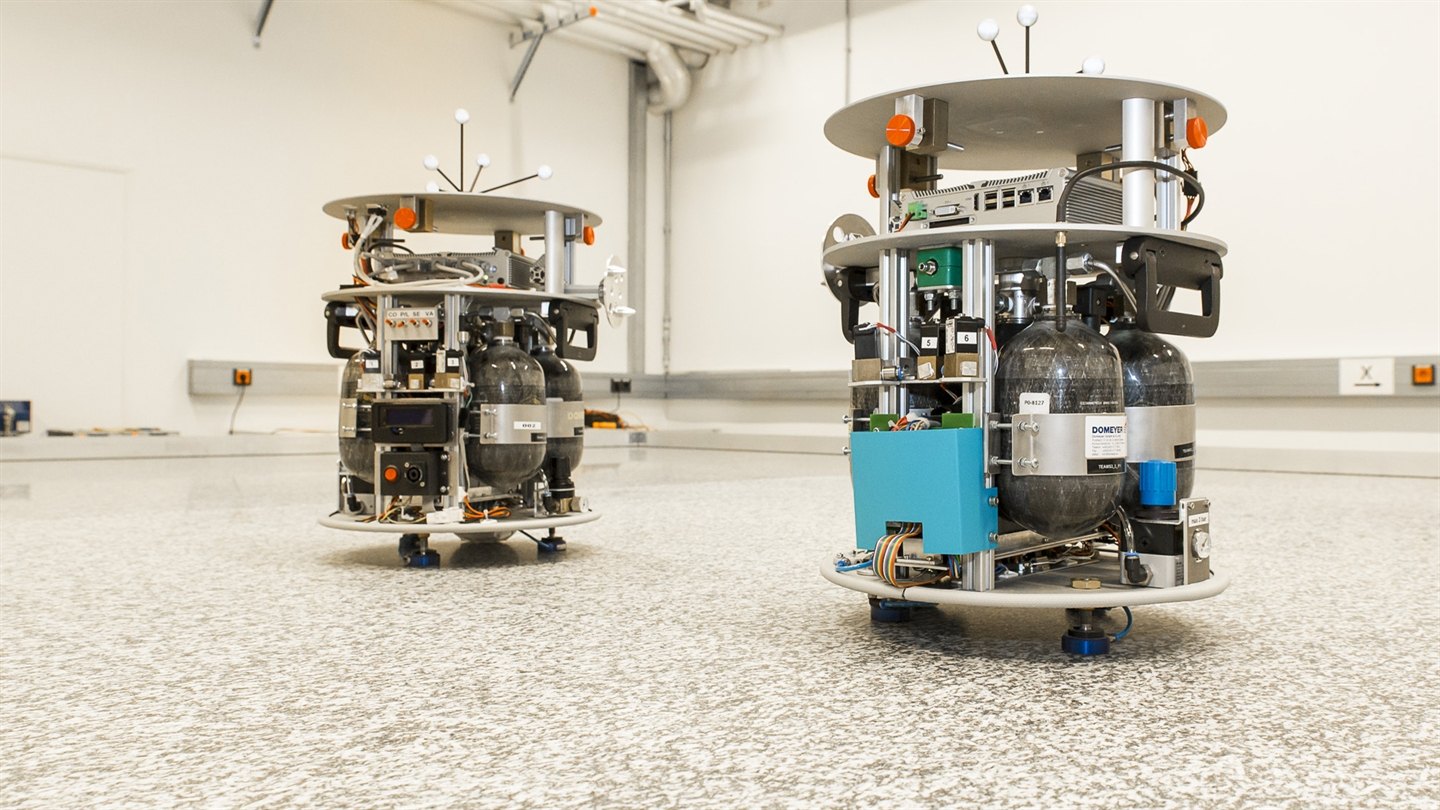
The Test Environment for Applications of Multiple Spacecraft floats vehicles on air bearings across two facilities, planar tables for 3-DoF work and combined bearings reaching toward 5-DoF, serving docking, formation flight and on-orbit servicing studies.
Multiple vehicles is the distinctive part: rendezvous is a two-body problem, and a bench that floats both bodies tests the interaction, not just one half of it.
ORBIT
ESA · ESTECEurope’s largest floating floor
The ORBIT floor in ESTEC’s Orbital Robotics and GNC laboratory is 4.8 by 9 metres of epoxy poured flat to under a millimetre, Europe’s largest 2D free-floating testbed. Air-bearing platforms drift across it under motion capture, and since its first trial in November 2015, a robot arm reaching out to touch a floating platform, it has hosted docking mechanisms, gecko-adhesive grippers and debris-capture rehearsals in which the contact forces are measured rather than modelled.
Epoxy is how a floor outgrows granite: nobody quarries a nine metre slab, so at this size flatness becomes a casting problem and the pour itself is the precision instrument.
ADAMUS
university labSix degrees on a budget
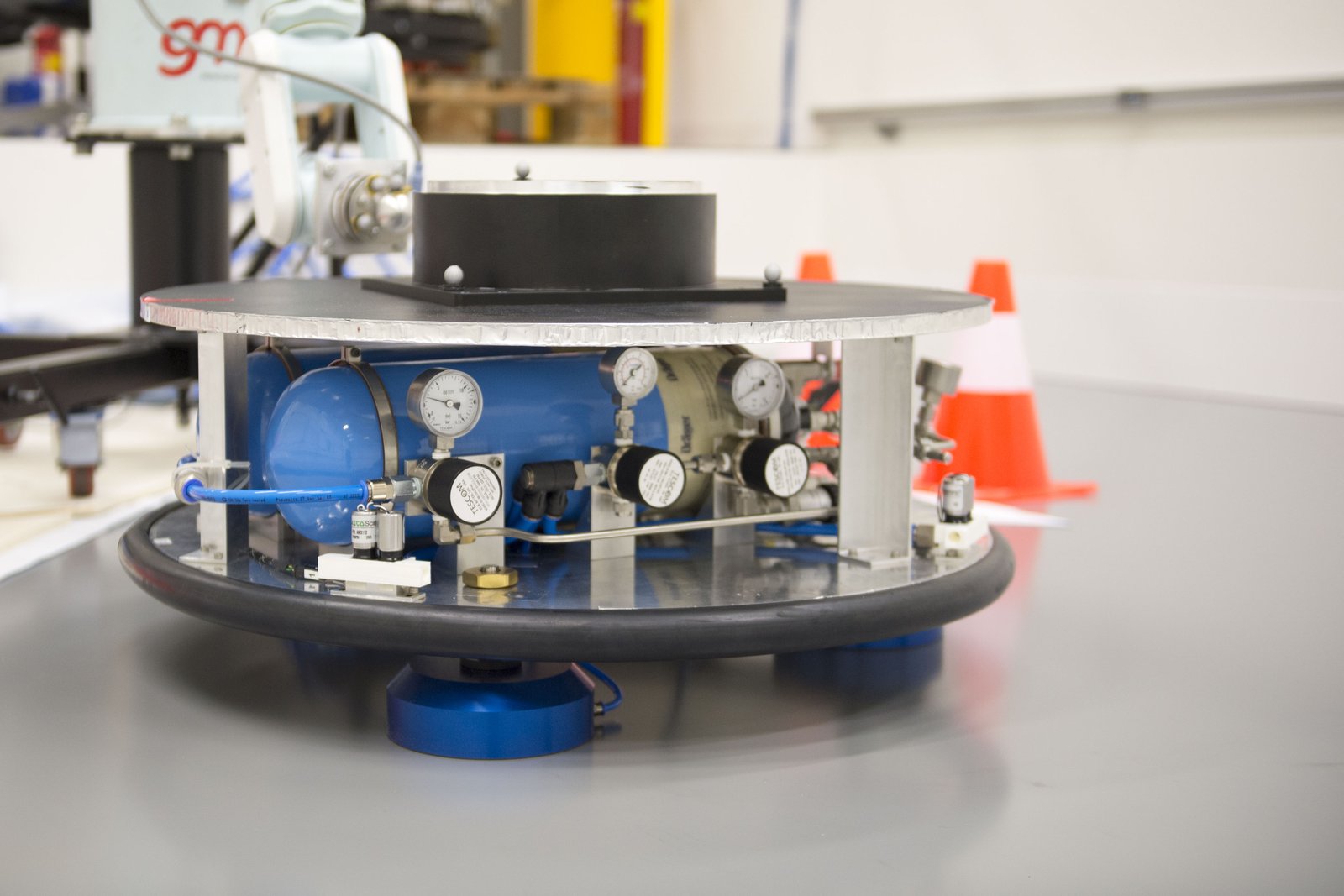
The ADAMUS laboratory line of air-bearing platforms, developed across American universities, stacks planar and spherical bearings to reach toward full 6-DoF relative motion at laboratory scale, supporting docking mechanism and control research.
University benches trade fidelity for iteration speed: a graduate student can rebuild the vehicle between mornings, which no agency facility can, and half the field’s control papers float on hardware like this.
POSEIDYN
Naval Postgraduate SchoolFour vehicles on one table
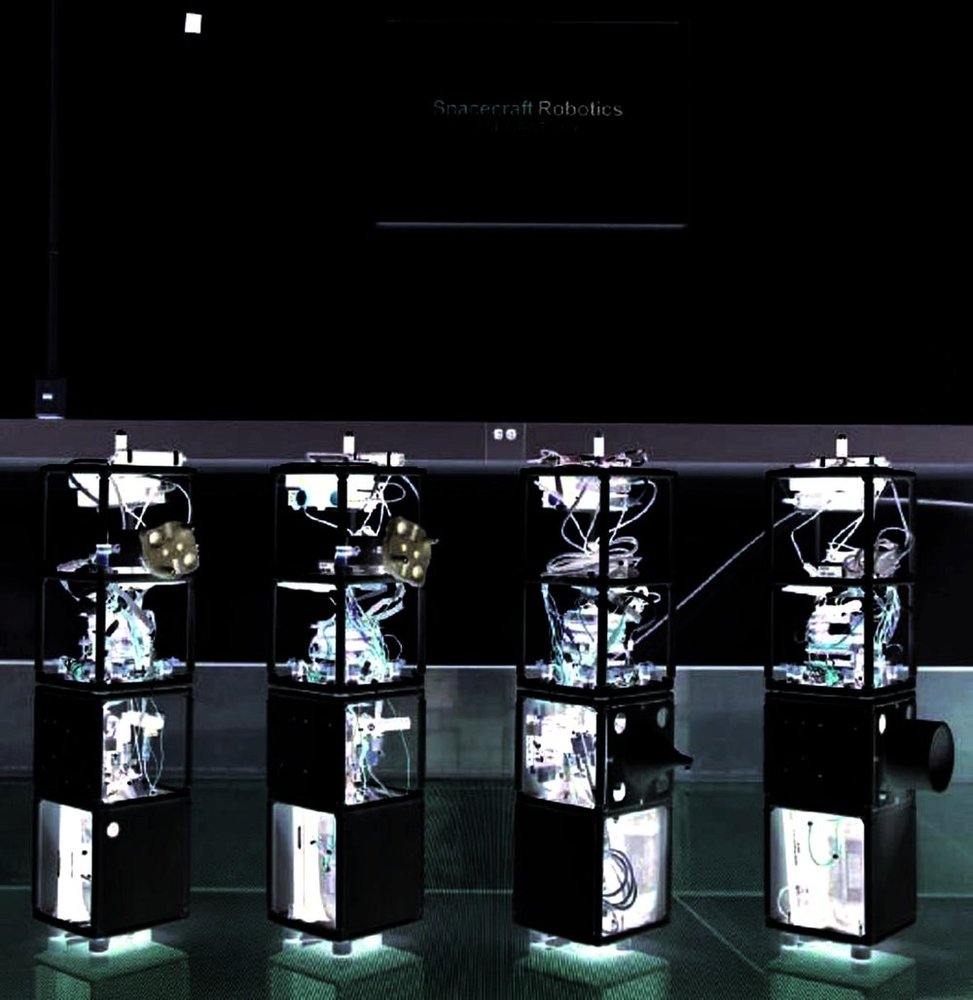
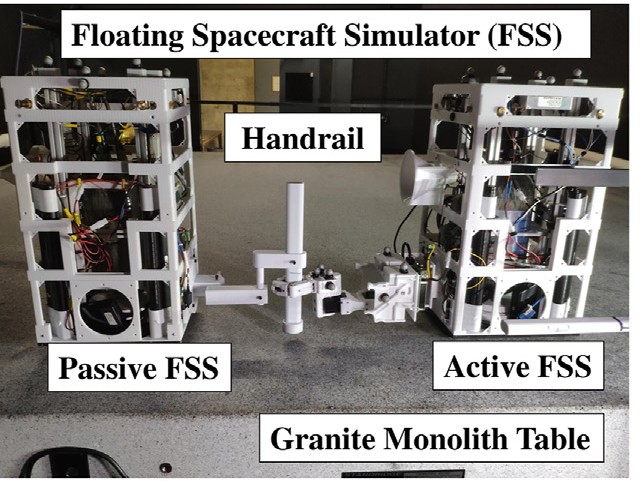
The NPS granite table floats multiple free-flying vehicles simultaneously, used for years of proximity operations and capture experiments, including early work feeding the servicing programmes.
The table is granite for the same reason telescope mirrors are: dimensional stability is what the air film rides on.
ASTROS
Georgia TechFive degrees, full attitude
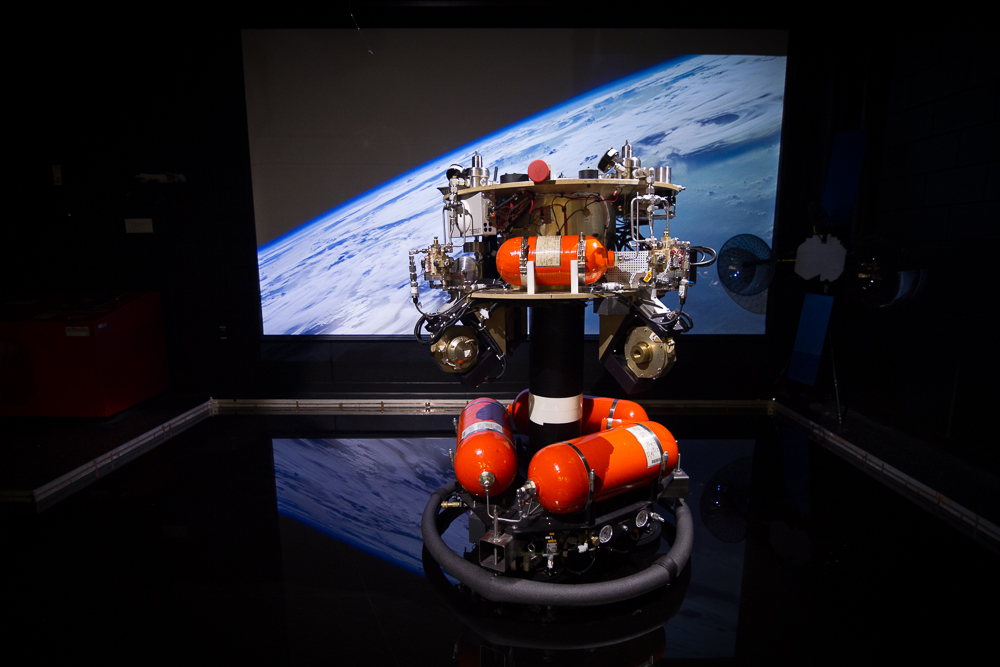
Georgia Tech’s Autonomous Spacecraft Testing of Robotic Operations in Space platform rides a planar bearing while its upper stage pivots on a spherical one, giving genuine coupled translation and attitude dynamics for control experiments.
The 5-DoF class is where attitude-translation coupling becomes real, which is exactly the coupling a docking controller has to survive.
M-STAR
Caltech · PasadenaSix degrees, one admitted
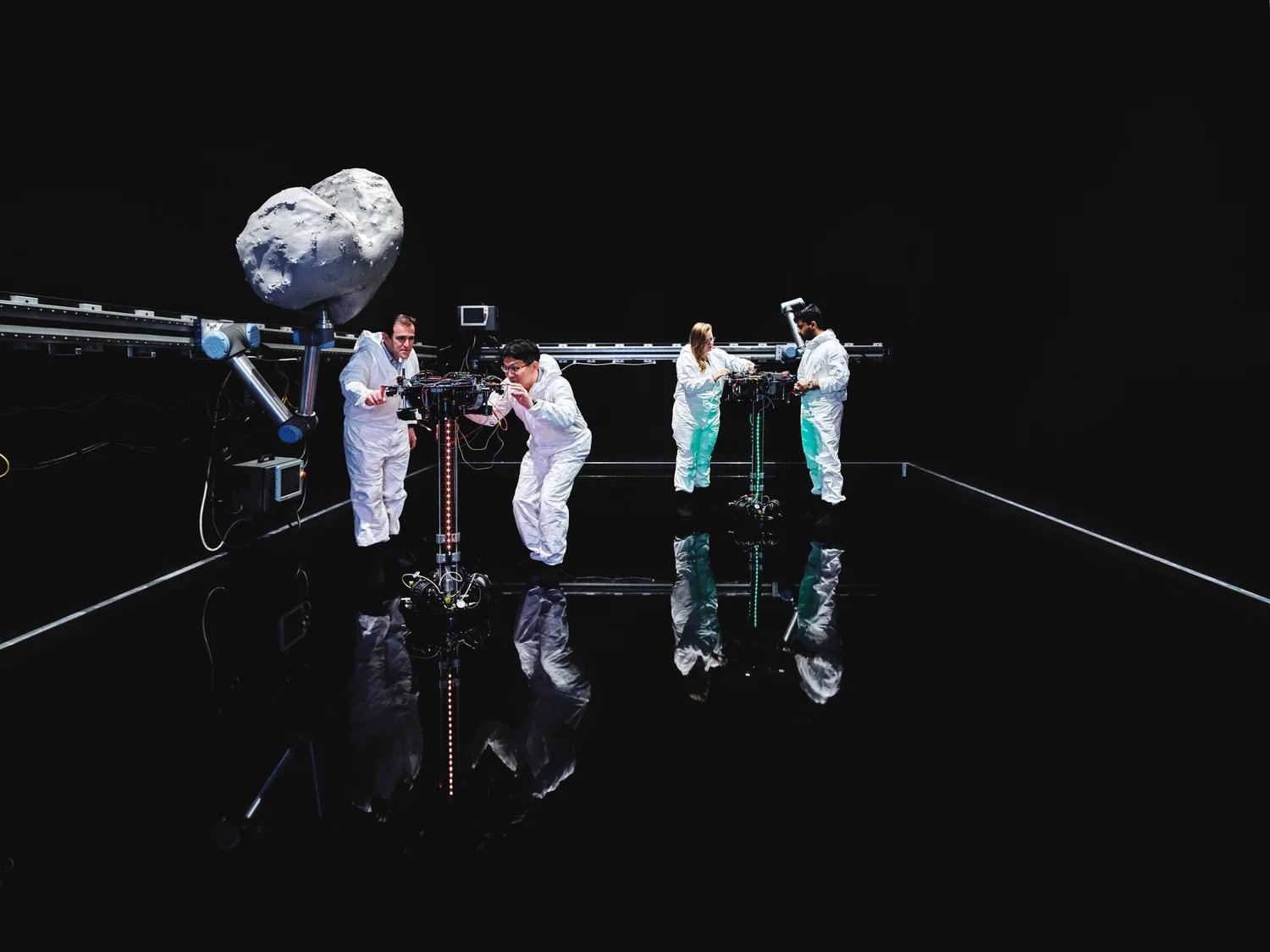
Caltech’s Aerospace Robotics and Control Lab floats its Multi-Spacecraft Testbed for Autonomy Research vehicles on one of the largest university-owned flat floors anywhere: planar and spherical air bearings give five frictionless degrees of freedom, a driven vertical stage supplies the sixth, and the same vehicle reconfigures between 3 and 6 DoF as a campaign demands. Several M-STARs fly together under motion capture for formation, swarm and on-orbit assembly research, including autonomous assembly experiments in a spinning target frame.
The vertical axis is actuated and the lab says so plainly, which is the honest version of the sixth degree: stating where the kinematics take over is worth more than claiming a float you do not have.
SPHERES
MIT / NASA · ISSThree spheres before the bees
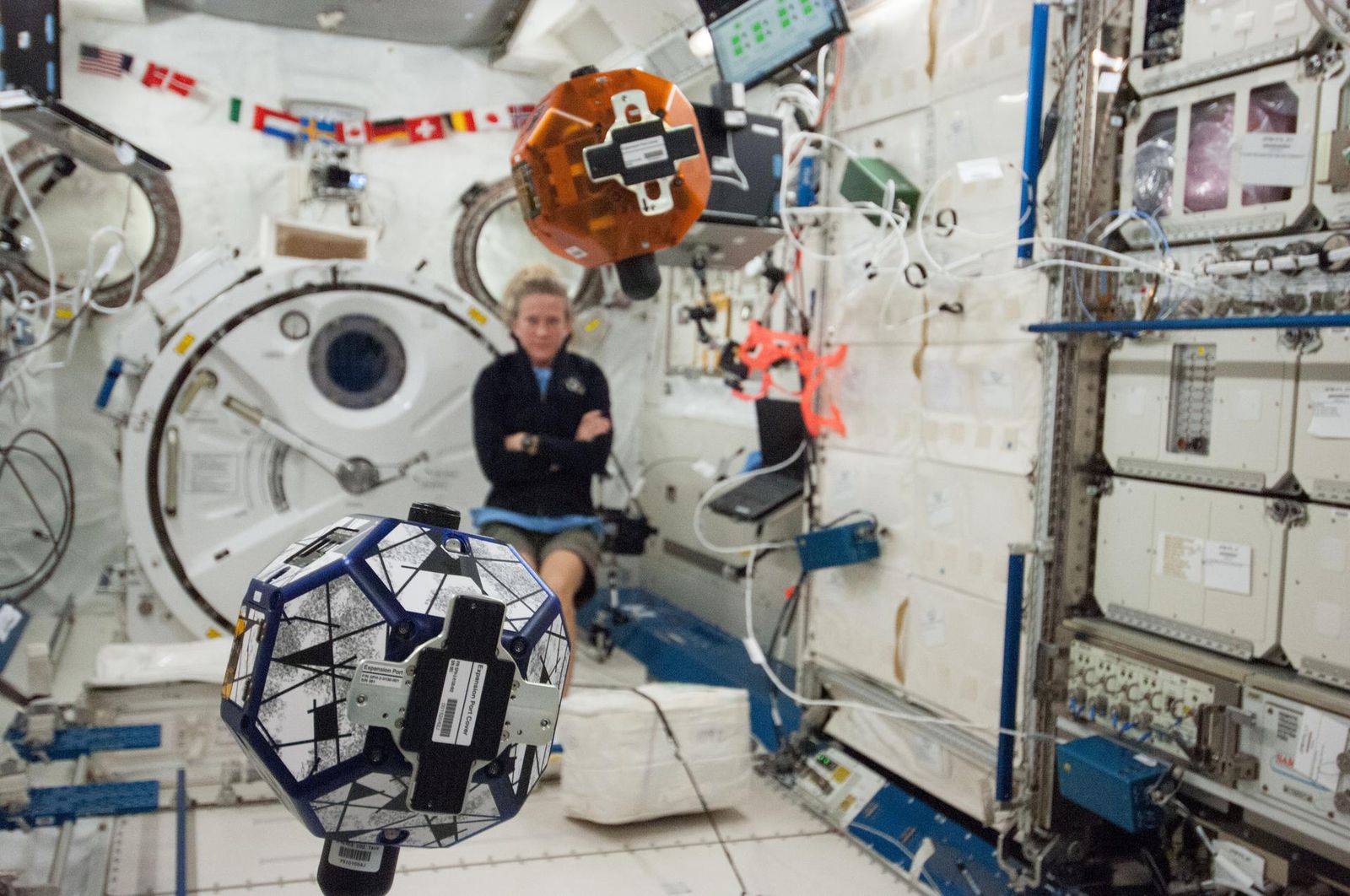
Astrobee’s predecessors were three bowling-ball-sized polyhedra that reached the station in 2006: MIT’s SPHERES, born when a professor showed his design class the Star Wars training remote and DARPA paid to have it built. Flying on CO2 cold-gas thrusters and disposable battery packs, the trio logged nearly 600 experiments in formation flight, docking and autonomy across more than a decade, including years of student-written control code from the Zero Robotics competitions, before retiring in 2019.
Consumables set the cadence: every thruster pulse spent CO2 that arrived by cargo flight, and the experiment schedule was written around the resupply manifest, which is the tax an orbiting bench pays for its perfect dynamics.
Astrobee
NASA · ISSThe bench that orbits
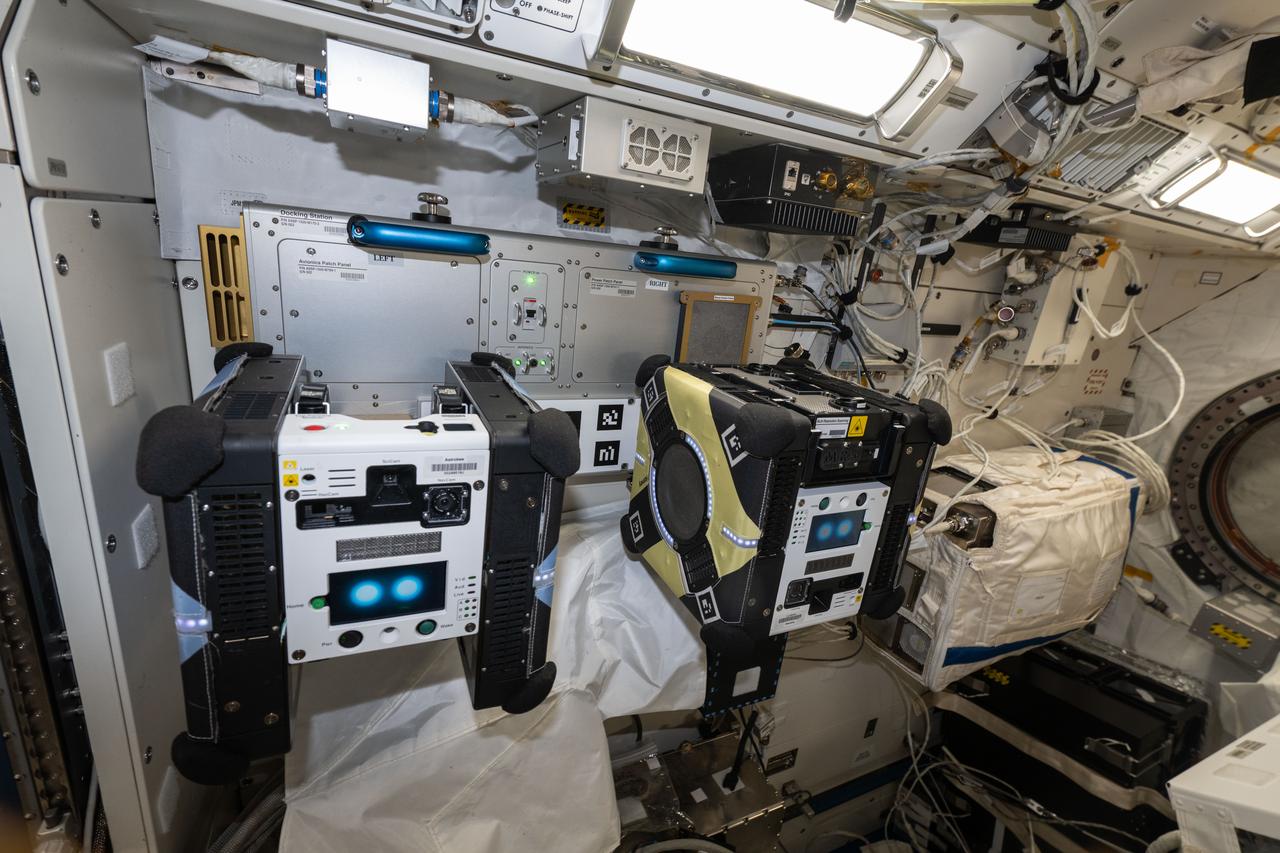
The honest sixth degree of freedom exists in one laboratory only. The Astrobee free-flyers aboard the ISS, successors to SPHERES, are cube robots that fly genuine 6-DoF relative motion inside the station, hosting guest algorithms for rendezvous, capture and inspection research.
An orbiting bench inverts every constraint: the dynamics are perfect and free, and the iteration time is measured in cargo flights. Ground floors and station free-flyers are complements, not competitors.
T minus 00:01:00 THE LIMIT
What the float cannot fake
No air film supplies orbital mechanics: the floor has no gravity gradient, no J2, no curvature, and a vehicle that station-keeps beautifully on granite has proven its controller, not its guidance. The full loop is closed by pairing the float with the kinematic halls of topic 13, and, for landing, with the benches of topic 15.